

Table of contents
IP protection ratings indicate how well an enclosure protects against contact, foreign objects and water. The abbreviation IP stands for “International Protection”, though it is also commonly known as “Ingress Protection” – meaning protection against intrusion. You may hear the term “IP protection class” used in everyday language, but this isn’t technically correct: protection classes relate to electrical voltage safety, whereas protection ratings refer to physical and water resistance. The IP prefix makes the distinction clear. In this guide, we explain what the individual digits mean and which IP ratings are suitable for indoor or outdoor use – complete with an IP rating chart covering the most common ratings.
Key facts about IP protection ratings
- IP stands for International Protection (also known as ingress protection) and defines how well enclosures protect against contact, dust or water. IP ratings are regulated by BS EN 60529 (general) and ISO 20653 (road vehicles).
- The protection rating uses a two-digit code IPXY: The first digit refers to touch and foreign object protection, the second to water protection. The higher the number, the better the protection.
- Common IP ratings in practice: IP20 for dry indoor areas (lamps, control cabinets), IP44 for damp rooms (kitchens, bathrooms, covered outdoor areas) and IP65 for dust-tight and water jet-protected environments (industrial settings with liquids or dust).
- Special requirements apply to bathrooms regarding IP protection in accordance with BS 7671 (the IET Wiring Regulations).
What is IP protection?
In industrial and commercial settings, electrical devices and systems face demanding conditions. Outdoors, they must withstand varying weather, while indoors they must cope with dust, chemical vapours and moisture. For this reason, devices must be installed in protective enclosures that shield them from damage.
IP protection ratings were introduced to address these varying environmental conditions. IP codes indicate how well a device is protected and are precisely defined in BS EN 60529. The international standard ISO 20653 also applies to road vehicles. Each rating uses a two-digit code following the pattern IPXY:
- The first digit (X) indicates protection against touch and foreign objects.
- The second digit (Y) indicates protection against water.
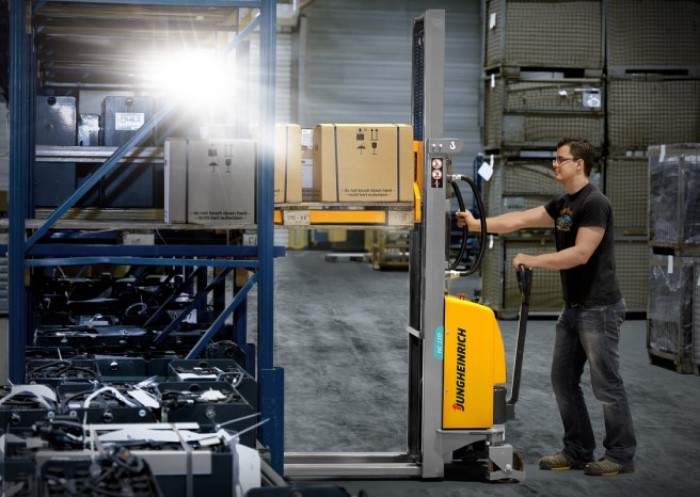
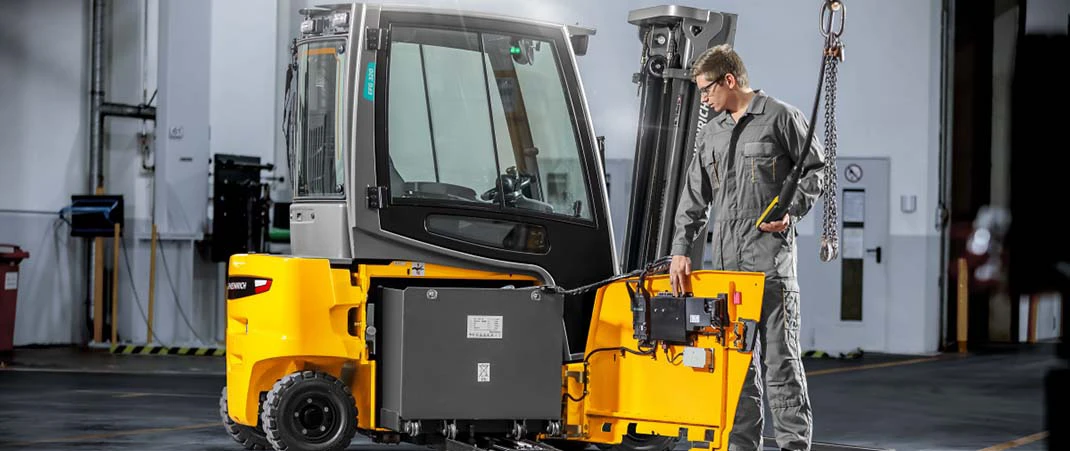
The electrical controls on our electric pallet trucks, lithium-ion stacker trucks and electric forklifts are, for example, protected by special encapsulation in line with their IP protection rating. This makes them resistant to external influences and extends their service life compared to unprotected industrial trucks.
IP protection digit 1: Touch and foreign object protections
The first digit of an IP code indicates how well a device is protected against contact (for example, with hands) and against foreign objects such as dust, stones or wire. The higher the number, the better the protection:
| BS EN 60529 | ISO 20653 | Protection against touch | Protection against foreign objects |
|---|---|---|---|
| 0 | 0 | No protection | No protection |
| 1 | 1 | Back of the hand | Larger solid foreign objects with a diameter of ≥50 mm |
| 2 | 2 | Fingers | Medium-sized solid foreign objects with a diameter of 12.5 mm or more |
| 3 | 3 | Tools/wire of 2.5 mm | Protection against smaller solid foreign objects with a diameter of ≥2.5 mm |
| 4 | 4 | Tools/wire of 1 mm | Very small solid foreign objects with a diameter of ≥1 mm |
| 5 | 5K | Full touch protection | Dust in larger, harmful quantities (full ingress) |
| 6 | 6K | Full touch protection | Dust-tight (no ingress) |
IP protection digit 2: Water protection
The second digit indicates protection against moisture and larger quantities of water. Again, the higher the number, the better the protection:
| BS EN 60529 | ISO 20653 | Water protection |
|---|---|---|
| 0 | 0 | No protection |
| 1 | 1 | Vertically falling water drops |
| 2 | 2 | Diagonally falling water drops when the enclosure is tilted up to 15° |
| 3 | 3 | Spraying water up to an angle of 60° |
| 4 | 4 | Splashing water from all directions |
| 4K | Splashing water from all directions with increased pressure | |
| 5 | 5 | Water jets from all directions |
| 6 | 6 | Powerful water jets |
| 6K | Powerful water jets with increased pressure | |
| 7 | 7 | Temporary immersion |
| 8 | 8 | Continuous immersion |
| 9 | Water from high-pressure or steam cleaning (in agriculture) | |
| 9K | Water from high-pressure or steam cleaning (road vehicles) |
IP protection ratings: IP rating chart overview
By combining digits 1 and 2, the IP code indicates a device’s resistance to contact, foreign bodies and water. If a digit is not relevant, it is replaced by an X. The code is then IPX4, for example. The table below shows the most common IP ratings:
| IP class | Protection level | Typical applications |
|---|---|---|
| IP20 | Fingers and solid bodies with a diameter of 12.5 mm or more | Lamps in dry interiors, control cabinets |
| IP23 | Fingers and solid bodies from 12.5 mm diameter and spraying water up to an angle of 60° | Lamps and devices in covered outdoor areas |
| IP40 | Access with wire and granular foreign bodies | Equipment in dry indoor areas where handling granules or coarse dust |
| IP44 | Access by wire and granular foreign bodies as well as splashing water from all sides | Lamps and devices in damp rooms, bathrooms and covered outdoor areas |
| IP54 | Contact protection, dust protection, and protection against splashing water from all sides | Indoor and outdoor areas, industrial facilities and workshops |
| IP55 | Contact protection, dust protection, and protection against water jets | Indoors and outdoors and in dry vehicle compartments |
| IP65 | Contact protection, dust-tight protection, and protection against water jets | Damp areas, outdoor areas, and industrial facilities where work is carried out with liquids or very dusty materials |
| IP67 | Contact protection, dust-tight protection, and protection against temporary immersion | Damp areas, outdoor areas, showers and baths, and near water |
| IP68 | Contact protection, dust-tight protection, and protection against continuous submersion | Damp and outdoor areas, baths, and inside bodies of water like water tanks and troughs |
IP protection in the bathroom: Which protection rating is required?
In dry indoor spaces, you rarely need devices with water ingress protection. However, in kitchens and especially bathrooms, moisture and splashing water are common. This is why luminaires, for example, must have the appropriate water protection rating. This is stipulated by BS 7671 (the IET Wiring Regulations) which divides bathrooms into zones. The specific requirements are:
- Zone 0 (inside the bath or shower): minimum IPX7 (protected against temporary immersion)
- Zone 1 (above the bath or shower up to 2.25 m): minimum IPX4, or IPX5 where water jets are likely
- Zone 2 (up to 60 cm beyond Zone 1, up to 2.25 m height): minimum IPX4 (protection against splashing water)
These are the minimum requirements for bathroom IP ratings. There’s nothing wrong with installing devices and luminaires with a higher rating such as IP67 throughout damp rooms. In fact, this can make sense from a safety perspective even in normally dry spaces – for example, during construction work when a roof is temporarily removed and rainwater could penetrate from above.

FAQ for IP protection ratings
“IP” stands for “International Protection” or “Ingress Protection”. The first digit indicates protection against impacts and solid foreign objects or dust (0–6). The second digit indicates protection against water (0–9 or 9/9K depending on the standard).
Electrical devices must function reliably in both outdoor and indoor environments:
· For dry indoor areas, IP20 (finger/touch protection, not dust-tight) is often sufficient.
· In zone 0 (inside the tub/shower), at least IPX7 is required. In zones 1 and 2, IPX4 is sufficient (or IPX5 where there are water jets).
An IP rating tells you whether an electrical device is suitable for specific environmental conditions (e.g. moisture) and can be used safely. For example, any product labelled “waterproof” should always display its corresponding IP rating.
Note that IP ratings are test-dependent – factors such as immersion depth and duration are specified by the manufacturer.
For dry indoor areas, IP20 is perfectly adequate. For environments with fine particles or dust, we recommend IP5X (dust-protected) or IP6X (dust-tight); IP40 only protects against particles ≥1 mm. In damp rooms such as bathrooms, kitchens or industrial facilities handling liquids, at least IP44 is required.
If a device is exposed to water jets, it should meet IPX5 or IPX6. For temporary or permanent immersion, IPX7 or IPX8 ratings are suitable. For bathrooms specifically, BS 7671 sets out the requirements.
Outdoor devices must withstand changing weather conditions. Close to the building – on a balcony or under a canopy, for example – IP23 or IP44 is usually sufficient. Devices fully exposed to wind, rain or snow require IP54, IP55 or IP67 ratings.
Protection ratings (IP codes) indicate how well a device resists contact, foreign objects, water and vapours. Protection classes, by contrast, relate to electrical safety – specifically, protection against hazardous voltages. This is particularly important for devices with metal housings: if insulation fails inside the device, the housing must not become live and cause electric shock.
Please note: The regulations mentioned above represent only a selection of the most important legal requirements. Please refer to the listed organisations and directives for more detailed information. If in any doubt, consult experts or contact the relevant regulatory authorities.
Image source:
© gettyimages.de – vgajic
© gettyimages.de – urbancow