
Table of contents
Forklifts are valued in daily operations for their practical features: they are manoeuvrable, robust and capable of stacking goods at various heights. However, these strengths can also present a safety risk – particularly if the forklift truck is used improperly or the operator lacks adequate qualifications. To minimise the risk of accidents, special safety regulations apply to operating a forklift.
In this guide, you will learn which forklifts you may operate with and without a forklift licence, when the risk of accidents is particularly high, how to improve safety when driving a forklift, and which legal regulations apply to forklift driving.
This article provides an overview of guidelines and safety information relating to counterbalance forklift trucks. Industrial trucks such as pallet trucks or stacker trucks are not covered here.
Workplace accidents involving forklifts: What are the most common safety hazards?
Common hazards when operating a forklift truck include the vehicle tipping over during turning and braking manoeuvres, cornering, rapid changes of direction, or shifts in the centre of gravity of the goods being transported. Forklifts also travel with forks protruding forward – at speeds of up to 20 km/h.
As a result, both the dimensions of forklift trucks in relation to aisle width and the driving behaviour of the operator are crucial for warehouse health and safety.
According to the British Safety Council, approximately 25% of workplace transport injuries are caused by forklift accidents, and cause around 1,300 UK employees to be hospitalised each year with serious injuries. That’s around five UK workers suffering debilitating and potentially life-threatening injuries each day. The most common incidents involving the operation of forklifts include:
| Type of accident | Causes |
|---|---|
| Collision accidents where the forklift injures a third party | • Excessive speed • Inadequate visibility · missing floor markings • Narrow aisles and manoeuvring areas · inattention or negligence by the operator or the injured party |
| Forklift tips over when lifting a load or cornering | • Exceeding the permissible load capacity • Uneven load distribution • Excessive speed |
| Load falling from height | • Load inadequately secured • Small parts becoming loose • Faulty packaging |
| Joint, tendon and ligament injuries when mounting or dismounting the forklift | • Jumping down from a great height • Uneven ground • Slipping from steps |
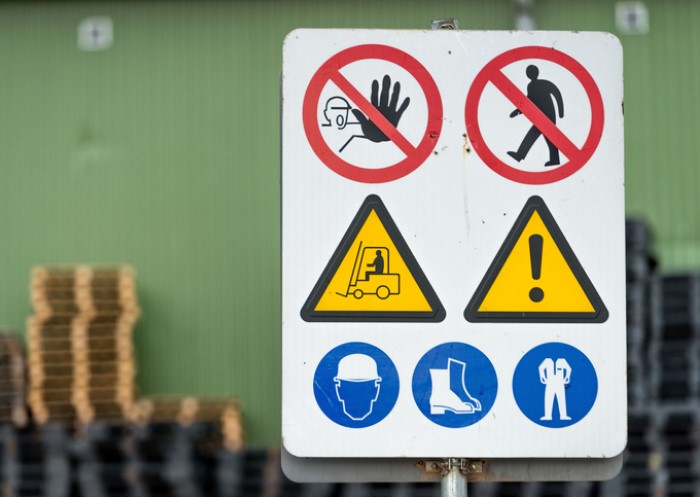
Whilst injuries from mounting and dismounting only affect the forklift operator, a tipping forklift, falling loads and collisions can also endanger and injure bystanders. This is particularly dangerous when goods fall from a great height, for example in a high-bay warehouse. For this reason, operators should receive regular safety training, and all personnel should be informed about handling equipment in the warehouse – particularly regarding safety during forklift operations. You should also ensure that the safety signs are clearly visible.
How to drive a forklift safely: These 12 points minimise accident risk

Follow these guidelines to prevent accidents and operate a forklift safely:
- Only authorised personnel may operate forklifts
Forklifts should only be operated by authorised personnel who have received appropriate training and written authorisation from the company. To prevent unauthorised access, always remove the key and store it in a secure location. Depending on the model and configuration, the forklift can also be secured against unauthorised access using chip cards or PIN codes.
- Conduct safety training for forklift operators
Thorough and regular training sessions ensure your employees understand which safety regulations apply when operating a forklift and how to implement them in practice.
- Display operating instructions for behaviour in areas with forklift operations
These operating instructions serve as the basis for training all employees and should then be displayed at relevant locations throughout the premises.
- Provide personal protective equipment throughout the working environment
Personal protective equipment includes wearing a safety helmet, safety footwear and high-visibility vest (in outdoor areas).
- Carry out daily visual and functional inspections of the forklift before starting work
A daily visual and functional inspection before use allows you to identify technical defects and take the forklift out of service if necessary. The inspection must also be carried out for all attachments.
- Regelmäßige Perform regular repair and maintenance work
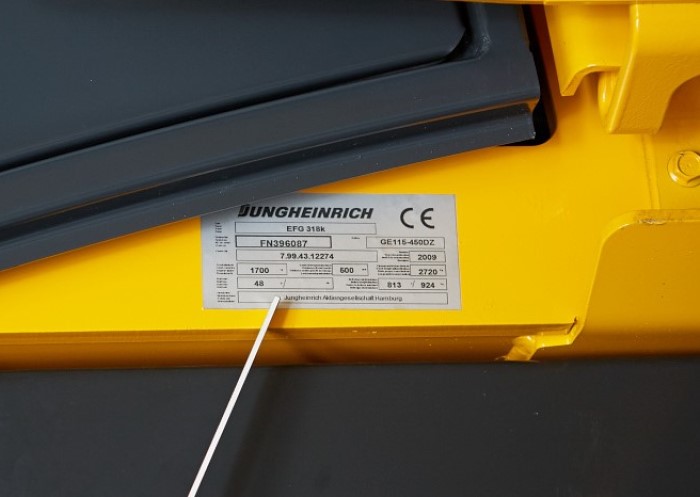
The manufacturer or appropriately certified companies carry out annual inspections and maintenance work under service contracts to ensure that the forklift trucks function in accordance with regulations. The inspection certificate is displayed on the forklift with a sticker. Without proof of inspection, you may not operate the forklift.
- Ensure proper use and marking of traffic routes
Traffic routes must be wide enough and kept clear of obstacles, with adequate floor marking systems and warning signs in place. Where aisles serve as both transport and pedestrian routes, barriers are recommended. Panoramic mirrors at junctions prevent the risk of collisions. Using the horn when turning also alerts employees to approaching forklift trucks.
- Observe speed limits
Keep the forklift to a maximum speed of 8 km/h on company premises (slower when carrying heavy loads), allowing you to brake immediately if an unexpected obstacle appears.
- Ensure good visibility
To ensure good visibility when driving a forklift, always travel with the load lowered (this is mandatory). If visibility remains restricted, reverse the forklift. It is also advisable to switch on the forklift lights for safety, even in well-lit areas.
- Correct driving behaviour prevents tipping hazards
Always move the forklift with the load lowered. Approach ramps and inclines straight on and negotiate gradients in reverse where possible. To prevent the forklift from tipping when cornering, reduce your speed accordingly.
- Inspect the load and ensure proper load securing
Depending on the type of load, you can secure it using straps or stretch film to ensure pallets are wrapped correctly. Before picking up a pallet with the forks, check the load for damage. Anti-slip mats provide additional protection for transported goods and improve workplace safety.
- Use electronic driver assistance systems
Electronic driver assistance systems enhance safety by sounding alerts when there is a risk of tipping, collision or falling loads.
Which forklifts may be operated without a forklift licence?
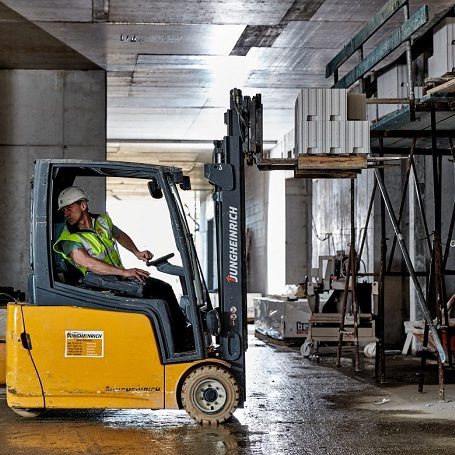
When it comes to industrial trucks, the training and education of operators is essential for workplace safety. However, different regulations apply depending on the forklift model and work situation. As a rule:
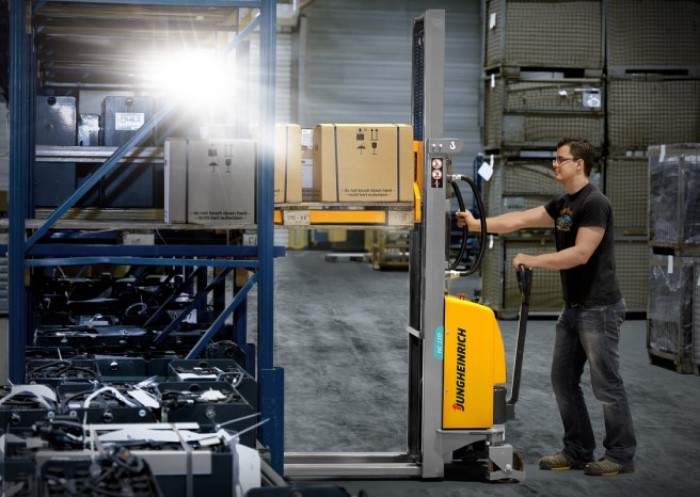
- For industrial trucks that have no driver’s seat or driver’s platform, i.e. those that are pulled or pushed, formal operator certification is not typically required. This includes pedestrian-operated stacker trucks, for example. However, employers must still ensure operators receive adequate training under PUWER.
- The HSE recommends refresher training every 3–5 years for all forklift operators, though this is not a fixed legal requirement.
- For forklifts with a driver’s seat or platform, you need formal training and certification, even if you are only driving within a warehouse or on company premises.
- For rough-terrain telehandlers, special training is required. Standard forklift training is not sufficient.
- While medical examinations are not legally mandatory, the HSE recommends that employers assess the physical and mental fitness of operators, particularly for higher-risk environments.
- To drive a forklift on public roads, you need a full UK driving licence (Category B) as a minimum. The forklift must also be registered, taxed and insured for road use.
You can obtain the industrial truck operator certificate (commonly known as a forklift licence) through approved training centres or certified companies, such as forklift manufacturers. In the UK, the legal framework is provided by the Health and Safety at Work Act and the Provision and Use of Work Equipment Regulations (PUWER).
Learning how to operate a forklift
Once you have company authorisation, you can register for training with an accredited provider such as those approved by RTITB, ITSSAR, AITT or NPORS.
To gain certification, you must complete three separate assessments: a theory test, a practical driving test, and a pre-use check test. The theory assessment format varies by provider and may include multiple-choice questions, written answers or oral questioning. The practical assessment typically lasts 35 to 70 minutes, depending on the accrediting body, during which you must demonstrate safe operating skills and complete standard driving and stacking exercises. Assessments can be retaken if necessary.
Even if employees already hold a forklift training certificate and are formally qualified to drive a forklift, this does not replace familiarisation training for the specific equipment and workplace they will be operating in. This on-site training, conducted under supervision, covers the specific functions of the forklift model and internal company procedures in detail. Only after completing all three stages – basic training, specific job training, and familiarisation – can an employer authorise an operator to work independently.
Approximate costs for forklift training
Forklift training costs vary depending on the provider, course duration and type of certification. Generally, they range from approximately £200 to £800.
Examples of forklift training costs: A novice operator training course typically costs between £450 and £600 for a three to five-day programme. Refresher courses typically cost between £150 and £200. Conversion training for experienced operators moving to a new truck type cost approximately £250 to £350.
These figures are approximate and intended as a guide only. Prices vary by provider, location, and whether training is conducted at the provider’s centre or on-site.
Legal requirements for operating a forklift
The key safety regulations for forklift trucks in the UK are governed by the Health and Safety at Work Act 1974, the Provision and Use of Work Equipment Regulations 1998 (PUWER), and the Lifting Operations and Lifting Equipment Regulations 1998 (LOLER). The Approved Code of Practice (ACOP) L117 provides specific guidance on rider-operated stacker trucks and is essential reading for all employers and operators.
A key requirement concerns the prerequisites an employee must meet before being permitted to operate a forklift:
- Operators must be at least 16 years old (minimum school leaving age). However, in ports and docks, the minimum age is 18. Operators under 18 should receive ongoing supervision and guidance. Note: Many employers set 18 as their company policy due to the high-risk nature of forklift operation.
- Additionally, appropriate training and certification, instruction on the specific vehicle, and written authorisation from the employer are required.
In addition to the requirements for the operator, the regulations also cover all other aspects that you must consider for the responsible and safe use of forklift trucks. These include:
- Forklift stability
- Load capacity
- Load securing
- Driving behaviour (laden and unladen)
- Picking up, setting down and stacking loads
- Mounting and dismounting
- Leaving and securing the forklift
- Traffic management in the warehouse and premises (required aisle width for the forklift and pallet truck dimensions, behaviour in narrow-aisle warehouses)
- Daily functional inspection before work
- Thorough examination by a competent person – at least every 12 months under LOLER (or every 6 months for equipment that lifts persons)
Detailed guidance on implementing these requirements in daily operations can be found in the HSE’s Approved Code of Practice and supplementary documents. By following these comprehensive safety regulations, you can help prevent forklift accidents in your workplace.
FAQ on driving a forklift
Most forklift-related workplace accidents are caused by poor visibility, exceeding the load capacity, incorrect load distribution, inadequate load securing and excessive speed. In the worst cases, these factors result in collisions, falling loads or the forklift tipping over.
Special care is required not just when driving a forklift – the entire operation and handling of the industrial truck demands vigilance. To minimise accident risk, ensure the following measures are in place:
• trained and well-instructed personnel
• regular functional inspections of the forklift
• compliance with health and safety regulations
• careful load securing
• and cautious driving on company premises
In the UK, the Health and Safety Executive (HSE) regulates forklift use through the Health and Safety at Work Act 1974, the Provision and Use of Work Equipment Regulations 1998 (PUWER), and the Lifting Operations and Lifting Equipment Regulations 1998 (LOLER). The Approved Code of Practice L117 provides detailed guidance on operator training and safe operation. Additionally, the general provisions of workplace health and safety legislation apply.
The minimum age to operate a forklift is 16 (minimum school leaving age). However, in ports and docks, the minimum age is 18. Operators under 18 should receive ongoing supervision and guidance. Note that many employers set 18 as their company policy due to the high-risk nature of forklift operation. A standard car driving licence does not permit you to operate a forklift.
If you wish to drive a forklift truck on public roads, you need the appropriate driving licence category. A Category B licence (standard car licence) is typically required for forklifts and telehandlers on public roads. The vehicle must also be registered with the DVLA.
For industrial trucks with a driver’s seat or platform, such as counterbalance forklifts or telehandlers, you need accredited training and certification, even if you are only driving forklifts within a warehouse or on company premises. Different types of equipment require separate training – for example, a counterbalance forklift certificate does not cover reach trucks or telehandlers. For rough-terrain telehandlers, additional specialist training is required.
Please note: The regulations outlined here represent only a selection of the key legal requirements. For detailed information, please consult the documents listed above and any additional relevant legislation. If in doubt when implementing these requirements, consult a qualified expert.
Image source:
© Jungheinrich AG