


- Impact protection made from high-grade steel for indoor use
- 4 mm thick steel plate as underride barrier
- High signal effect thanks to yellow/black plastic coating
7 Working days

- Hot-dip galvanised hoop guard for outdoor use
- Black/yellow plastic coating
- Attachment via base plates for floor anchoring
7 Working days

- Solid hoop guard made from 48 mm steel pipe
- Yellow plastic coating with black signal stripes
- Knee rail for reliable impact protection
7 Working days
- Solid hoop guard made from curved steel pipe
- Enhanced safety thanks to additional knee rail
- Galvanised and plastic-coated for outdoor use
7 Working days

- Robust corner hoop guard with underride barrier
- Plastic-coated steel, corrosion-resistant
- Easily visible thanks to yellow signal colour
7 Working days

- Pram protection bracket for dowels made of quality steel.
- Heavy duty attachment with 3 mm wall thickness.
- Yellow plastic coating with black signal strips.
7 Working days

- Solid protection bar made of curved steel tube.
- Side wall mounting via insert sleeve (not included).
- Removable for
7 Working days
- Highly robust hoop guard for indoor use, diameter 76 mm
- Quality high-grade steel with a thickness of 3 mm
- Yellow plastic coating with black signal stripes for enhanced visibility
7 Working days

- The corner hoop guard offers reliable impact protection
- Signal colours ensure excellent visibility
- The hoop guard is hot-dip galvanised and thus protected against corrosion
7 Working days

- The hoop guard for indoor use has a diameter of 108 mm
- The solid steel construction features a material thickness of 3.6 mm
- 2 base plates are integrated for straightforward assembly
7 Working days
- Extremely robust hoop guard made from hardened high-grade steel
- Offers reliable protection for building sections, pipes, pillars etc.
- Excellent visibility thanks to yellow plastic coating with black signal stripes
7 Working days

- Steel pipe guard for outdoor use
- Reliable protection for (down)pipes and cable looms
- Straightforward wall mounting via practical floor and wall plates
7 Working days

- Steel hoop guard for indoor areas
- Curved steel pipe with additional knee rail
- Yellow plastic coating with black stripes
7 Working days
- Solid protection bar made of curved steel tube.
- Side wall mounting via insert sleeve (not included).
- Removable for
7 Working days

- Solid protection bar made of curved steel tube.
- Lateral, durable wall mounting.
- More safety thanks to additional knee bar.
37 Working days

- Solid protection bar made of curved steel tube.
- Lateral, durable wall mounting.
- More safety thanks to additional knee bar.
33 Working days

- Durable and highly robust hoop guard made from high-grade steel
- Yellow/black contrast stripes for enhanced visibility
- The plastic-coated corner hoop guard is easily installed thanks to the integrated base plates
7 Working days

- Allows flexible use of protective brackets
- Corrosion resistant thanks to hot dip galvanizing
- Suitable for indoor and outdoor use
7 Working days
How to find the right impact protection barriers
Impact protection barriers are practical, versatile collision protection devices. HSE guidance recommends the use of impact protection measures for businesses with forklift traffic. The protectors may also be necessary for fall protection. Even when they’re not legally necessary, impact protection barriers help prevent accidents and damage to people and equipment.
- Impact protection barriers secure areas where objects may fall, such as at the base of multi-tier industrial shelving.
- They mark traffic routes and maintain a safe distance between pedestrians and vehicles.
- They prevent vehicles from entering work areas where hazardous substances, fire or machine tools are handled.
- Impact protection barriers can be used as part of fall protection systems at stairwells, ledges and platforms.
- Corner protectors protect building corners, drainpipes or technical installations from vehicle collisions.
Our range includes steel collision protection barriers for embedding in concrete, U-shaped designs, and curve and corner protection.
1. Selecting impact protection barriers by application
You can find a variety of barriers available in our online shop. Each type of barrier is designed to meet different requirements:
| Barrier type | Application | Dimensions and Features |
|---|---|---|
Inverted U-shape, with or without crossbars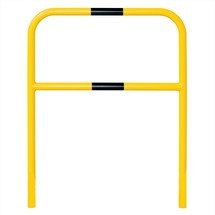
|
|
|
Pipe protection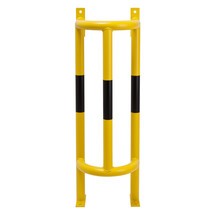
|
|
|
Two-part curved arch design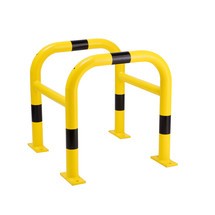
|
|
|
Angled profile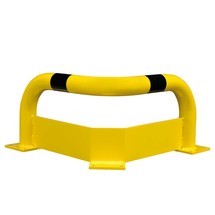
|
|
|
With underride barrier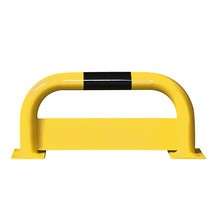
|
|
|
Our impact protection barriers are available with different thicknesses and diameters. Models with a thickness of 1.5mm and a diameter of 40mm are often used for indoor areas where heavy equipment or vehicles are not present. For areas where forklifts, other industrial vehicles or machinery are in operation, you will need impact protection barriers that are at least 3-4mm thick and have a diameter of at least 76mm.
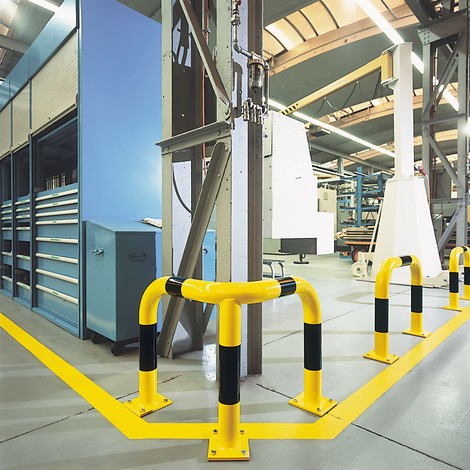
2. Impact protection barriers for indoor, outdoor and hygiene-sensitive areas
Our product range includes impact protection barriers suitable for indoor and outdoor areas across all types of businesses.
- Our indoor protection bars have a practical and lightweight design. They can easily be screwed into the floor.
- We offer hot-dip galvanised impact protection barriers with specially hardened steel tubing for indoor areas with high humidity or extreme low temperatures, as well as outdoor installations. These barriers are corrosion-resistant, weatherproof and highly durable.
- For hygiene-sensitive areas such as when working in the food industry, we supply impact protection barriers made from abrasion-resistant solid plastic with steel reinforcements. They can be installed using floor anchors and plates.
FAQ for Impact protection barriers
According to HSE guidance, special care must be taken to protect employees in businesses where vehicles such as forklifts or pallet trucks are in operation. You must also perform a risk assessment.
Industry standards and HSE guidance provide recommendations on dimensions and colour schemes for collision protection bars. Yellow-black warning markings are standard practice to ensure visibility.
Depending on the facility, building regulations and workplace safety requirements may also apply to the installation of impact protection barriers, for example where load-bearing pillars must be protected from forklift collisions.
Generally, impact protection barriers can be either bolted down or concreted in. Correctly installing impact protection is essential in ensuring the required level of collision protection. In the event of impact, it must be impossible to tear the barrier from the ground.
The appropriate installation method depends on the surface you are working with:
- Bolt-down impact protection barriers: These require a solid, level concrete floor with no cracks or holes. The barriers can also be secured with a suitable industrial adhesive on asphalt surfaces.
- Collision protection bars for concreting: If the surface is unsuitable for bolting, you can use impact protection barriers designed for concreting in. Ensure that the concrete foundation is frost-resistant for long-term outdoor use.
The right impact protection barriers for you depend on various factors:
- Intended application: Protection bars are available in various shapes for different applications. You should select your product according to its intended use, e.g. protecting warehouse racking, pipes and conduits, corners and angles, or separating traffic routes.
- Indoor or outdoor use: All impact protection barriers are suitable for indoor use. Models with corrosion protection are required for outdoor areas.