
Table of contents
Modern warehouse and logistics processes would be unimaginable without pallets. These sturdy wooden structures are used to store and transport a wide variety of goods. Loading pallets requires special care: unevenly distributed or inadequately secured goods can cause workplace accidents or damage during transport. This guide covers everything you need to know about palletising, from best practices to the different techniques available.
Palletising: Key information at a glance
- What is palletising? Palletising encompasses all processes involved in loading goods onto pallets. The aim is to create uniform, stable packaging units for efficient and safe transport, storage and handling.
- Palletising correctly: Even load distribution and proper load securing are the two most important factors in palletising. Avoid overhangs and gaps wherever possible, ensure the weight is evenly balanced, and always stay within the permitted load capacity.
- Various palletising techniques: The right technique will depend on the nature of your operation and its specific requirements. Manual palletising suits operations with lower volumes, whilst high and regular throughput calls for automated solutions such as palletising robots, layer palletisers or pallet loading stations.
- Common palletising mistakes: Poor stacking can result in unstable towers or shifting loads. If deformations occur due to uneven distribution or overloading, do not attempt to fix them with tensioning straps or similar – instead, adjust the alignment or reduce the number of layers.
What are the functions and benefits of palletising?
Palletising is a term used across logistics and warehouse planning to describe the loading of goods onto pallets for transport or storage. The aim of palletising is to combine raw materials or products into packaging units that are as uniform as possible, so that even larger quantities can be moved safely and efficiently using pallet trucks, stackers or forklift trucks.
Palletised goods form a stable, space-efficient unit that offers far greater protection against external influences and transport damage than loose loads.
Benefits of palletising at a glance:
- Industrial trucks make loading and unloading faster and more efficient
- Stacked goods enable faster transport and goods flow in the warehouse
- Stacking goods and pallets optimises the storage space available
- Safety is increased for employees and goods alike
How do you palletise correctly?
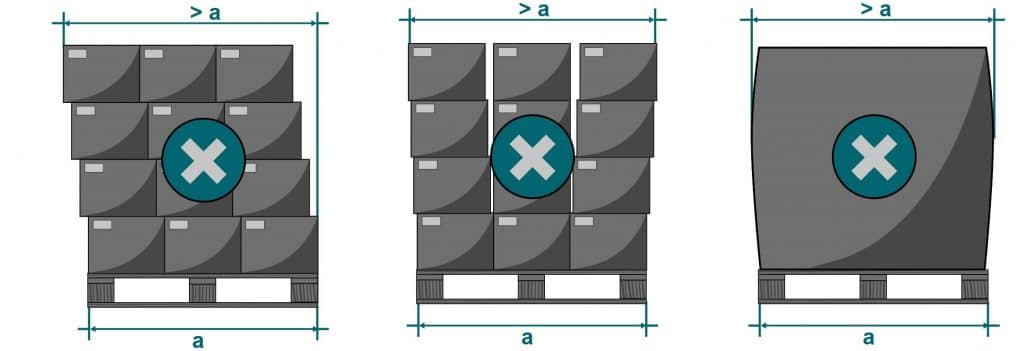
Two things are particularly important when palletising: the distribution and securing of goods. The load must be stable enough not to shift or compress, which means loading evenly and always staying within permissible load capacities.
| Important for palletising | Explanation |
|---|---|
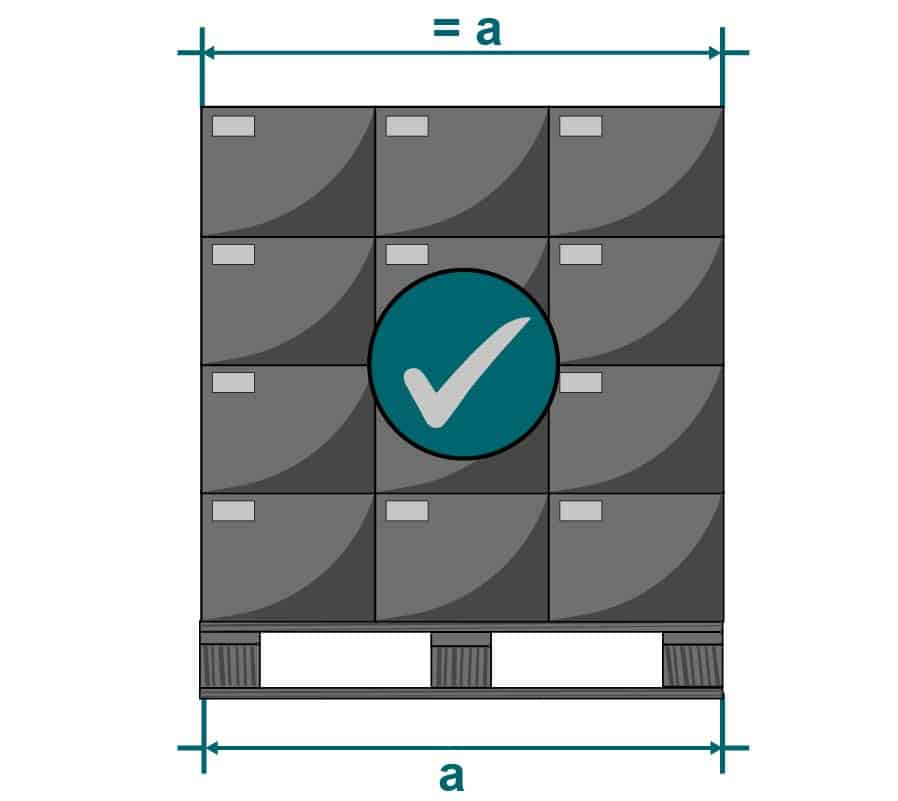
| Distribute the load evenly on the pallet | Place items in their packaging or in stackable containers, cartons and crates sized to fit Euro pallets. Avoid uneven gaps that could unbalance the load. Where gaps are unavoidable, keep the load centred or use deliberate spacing to achieve a more balanced arrangement. For overhanging loads, check that transport is still permitted and that your storage system can accommodate it. Always keep the weight evenly distributed – never top-heavy or lopsided. Not doing so can compromise safety, particularly when using a pallet chassis or forklift truck for transport. |
| Secure goods reliably | Appropriate load securing is essential for palletising and is legally required – not only to protect goods and transport vehicles, but also to prevent personal injury. After palletising, secure the packaging units together into a single compact load using stretch film, lashing straps or other suitable equipment. |
| Consider load capacity | The permissible load capacity also plays an important role in the palletising process. Remember that this does not only refer to the load-bearing capacity of the pallet, but also of the racking, stackers and pallet trucks. Observe the regulations for pallet racking when storing, and the load capacity of stackers and pallet trucks when transporting your pallets. |
What palletising techniques are there?
The right palletising technique depends on the volume and type of goods that you are handling, how frequently your employees palletise, and how much you want to invest in automation.
Manual palletising
If the workload is manageable, warehouse or production staff may be able to palletise by hand. In this case, column or interlocking stacking methods may be suitable.
- When you stack in columns, you place the crates layer by layer in the same pattern next to each other. This quickly creates individual towers that aren’t connected to each other. They are therefore less stable than cartons stacked in an interlocking pattern.
- When you stack in an interlocking pattern, you place the crates offset on top of each other: once the first layer of the pallet is filled, you begin the second layer by placing a crate on the gaps between the lower crates. The arrangement resembles that of a brick wall and ensures stable loading.
Robotic palletising / automated palletising
If your operation regularly ships large quantities of the same products, switching to automated palletising makes sense, as it saves time and costs in the long run. There is a wide range of automated palletisers to choose from, including programmable robots for mixed-item pallets and large loading stations that transfer complete stacks onto a pallet in one go.
The following mechanical palletising aids support the palletising process:
- Pallet loading stations allow pallets to be automatically loaded with compact stacks of goods.
- Layer palletisers combine crates or other containers into a layer and place them on a pallet.
- Collaborative robots, also known as cobots, can provide support with palletising. Linear robots follow a fixed stacking pattern, whereas palletising robots can be programmed to handle a variety of packing configurations.
Some systems also depalletise your incoming goods and can be combined with conveyor technology for goods distribution. With centralised palletising, one machine can cover a large number of steps.
Warehouse automation integrates all processes seamlessly, with large warehouses and production facilities seeing the greatest benefits. Using several palletising robots, each handling only one task or a few steps in the palletising process, is referred to as decentralised palletising and keeps you particularly flexible.
Depalletising
Depalletising is the opposite of palletising and refers to the unloading of goods from a pallet onto a production line or into the downstream processes. Depalletising is mainly used for incoming goods.
Depalletising can be carried out either manually or by using depalletisers. Their job is to separate goods from their pallets – picking individual items from Euro pallets, for instance, or transferring loads onto conveyor belts. Modern depalletisers operate using advanced technologies such as AI robotics or visualisation software.
What equipment helps with palletising?
The right pallet accessories can support you with safe palletising. You can use the following components:
- Pallet turners and pallet changers can be used for transferring goods or for replacing defective pallets without having to remove the load.
- Pallet lifters with tilt function simplify the ergonomic lifting and lowering as well as loading and unloading of pallets and other transport equipment. The devices can be tilted at various angles, so you always have the goods in view and convenient access to the load from the side.
- Pallet magazines are used for pallet storage and allow efficient access to load carriers. Thanks to these pallet dispensers, numerous pallets can be stored and accessed ergonomically.
- For small items, load securing with stretch film is recommended. You can apply this either manually or using a pallet wrapper.
- Two or four large crates can be well secured with lashing straps and strapping tape.
- For securing particularly heavy goods, combine several securing methods and use sturdy pallet collars. These are also recommended for palletising irregularly shaped goods and protect the load from shifting sideways and falling off.
What mistakes commonly occur when palletising?
Most palletising mistakes occur when stacking crates and distributing loads.
Once a pallet is fully loaded, check that it forms a neat rectangle with straight sides. With column stacking, towers tend to fan out or lean to one side as they get taller. A bulging shape is a sign that there are too many layers and the lower crates are being crushed under the weight.
Should this occur, correct the alignment or remove some layers from the pallet before securing the load. Never attempt to correct the shape with tensioning straps or stretch film. Deformations are a sign of instability that even good load securing cannot always compensate for.
Incorrect palletising:
Correct palletising:
FAQ for palletising
Palletising is a process in modern logistics. It refers to the systematic and uniform arrangement of products on a pallet to optimise the transport and storage of goods. This allows even large quantities of goods to be moved safely. Successful palletising therefore facilitates transport, protects goods from damage, optimises storage and transport capacities, and enables efficient goods handling.
The optimal palletising method depends on factors such as product type, goods throughput, budget, and the specific requirements of the company.
Manual palletising is flexible but also labour-intensive. Robot-assisted palletising – depending on requirements for individual workflows or entire work areas – saves time and human effort but also requires a high initial investment. There is therefore no one “correct” palletising method.
A palletiser is an automated system that performs various important tasks in industrial production and logistics, primarily the automatic stacking and arrangement of goods on pallets.
There are various types of palletisers, from conventional systems to modern palletising robots and collaborative robots (cobots), which are used depending on the application area and product type. Modern palletisers can handle various types of goods, including cartons and crates, film-wrapped products, sacks and other containers.
In addition to the standard Euro pallet, available in standard sizes, there are also other pallet types. The pallets used in a palletising operation depend on the respective operational processes and goods. In some industries, for example, strict hygiene regulations require the use of germ-free materials that can be disinfected, whilst others need particularly large or heavy-duty pallets.
Image source:
© Jungheinrich AG