
Table of contents
Safety signs are pictograms used in private and public buildings to warn of potential hazards, indicate prohibited or required behaviours, and help prevent accidents. They play a very important role in occupational health and safety and must be provided by employers wherever a significant risk cannot be avoided or mitigated by other means.
In this guide, you’ll learn about the different types of safety signs, the standards governing their design, and what to consider when installing them in the workplace.
Which standards apply to safety signs?
All safety signs, including their meaning, appearance and installation requirements, are governed by the following legislation and standards in the UK:
- The Health and Safety (Safety Signs and Signals) Regulations 1996: These regulations set out the minimum requirements for safety signs at work and apply wherever people are employed.
- BS EN ISO 7010 – Registered Safety Signs: This international standard, adopted as a British Standard, defines the appearance and colour of safety signs. It is regularly updated to include new registered signs.
- HSE Guidance L64 – Safety Signs and Signals: This guidance document from the Health and Safety Executive explains how to comply with the 1996 Regulations and provides practical advice on using safety signs effectively.
Important to know: Safety signs are required where there is still a significant risk to the health and safety of employees and others despite putting all other relevant measures in place.
If you have older safety signs that don’t comply with BS EN ISO 7010, replace them as soon as possible. Mixing old and new sign designs in the same area can cause confusion and should be avoided.
What are the five safety sign categories?
Safety signs regulated by BS EN ISO 7010 are identified by a letter and a three-digit number. Each safety sign can be identified as follows:
- P = Prohibition sign
- W = Warning sign
- M = Mandatory sign
- E = Safe condition sign
- F = Fire equipment sign
The regulations also allow for supplementary signs. These are displayed alongside the main safety sign to provide additional information. Under the 1996 Regulations, supplementary signs are primarily directional arrows. Any supplementary text must be accompanied by an appropriate pictogram. This includes text specifying exact prohibitions or mandatory requirements.
A combination sign displays the safety sign and supplementary information on a single panel.
The 1996 Regulations specifythe requiredshapes and colours for each sign type. This makes the meaning of any given sign immediately clear:
| Safety signs | Shape and colour | Examples |
|---|---|---|
| Prohibition sign (P) • Indicates behaviour that is prohibited | • Circular • White background • Black pictogram • Red border • Red crossbar • Circular • Blue background • White pictogram | 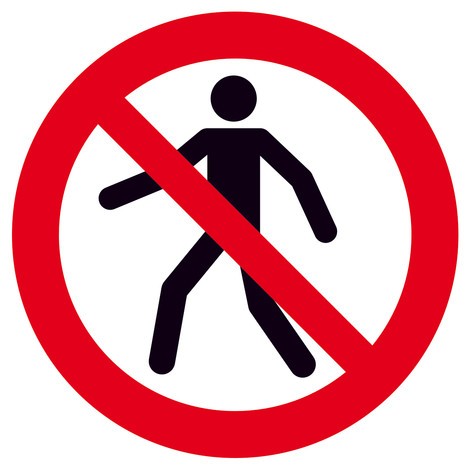 e.g. no smoking, no entry, no open flames |
| Mandatory signs (M) • Indicates safeguards that must be followed | • Circular • Blue background • White pictogram |  e.g. use ear protection, wear a safety helmet, use eye protection |
| Warning signs (W) • Indicates hazards | • Equilateral triangle • Yellow background • Black pictogram • Black border | 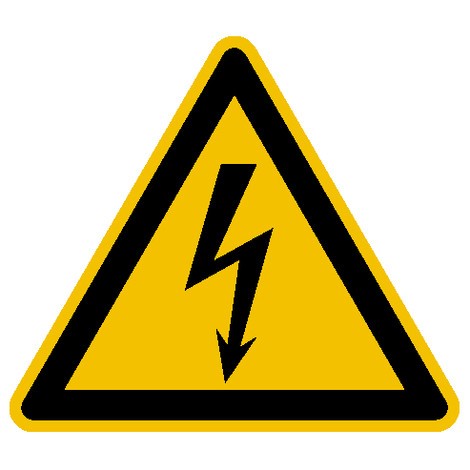 e.g. warnings about radiation, flammable substances, electrical voltage |
| Safe condition signs (E) • Indicates emergency exit routes, first-aid equipment and more | • Square or rectangular Green background White pictogram | 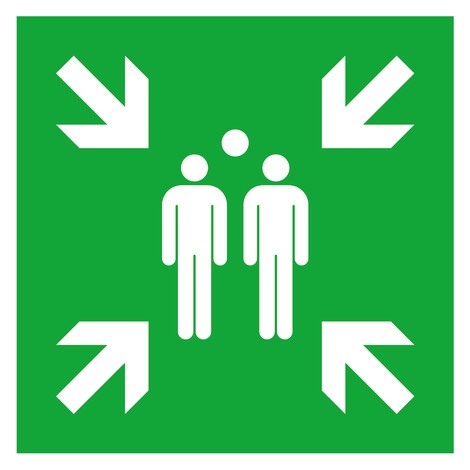 e.g. emergency exit, first aid, assembly point, escape route |
| Fire equipment signs (F) • Indicates the location of fire-fighting equipment | • Square, rectangular or circular • Red background • White pictogram | 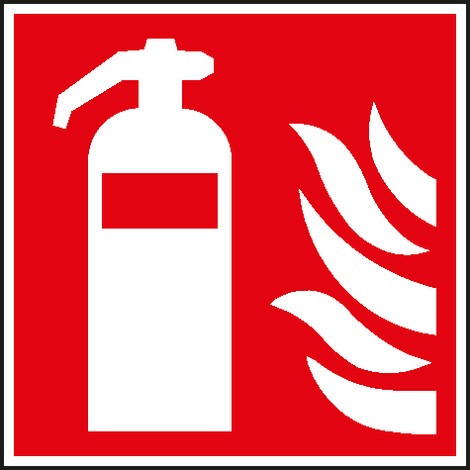 e.g. fire extinguishers, fire blankets, smoke alarms |
Which safety signs are required in the workplace?
Decisions about which safety signs to use and in what quantity are always based on a risk assessment. This assessment examines both the workplace and the specific activities being carried out. The Health and Safety (Safety Signs and Signals) Regulations 1996 require safety signs where:
- There is a significant risk to health and safety despite other protective measures
- Certain actions must be prohibited
- Safeguards need communicating (e.g. PPE requirements)
- Hazards must be highlighted
- Emergency escape routes and fire-fighting equipment must be clearly marked
In addition to safety signs, safety barriers and impact protection can help identify and protect hazardous areas.
Safety signs: Viewing distance requirements
In addition to the geometric shape and colour, the required viewing distance for safety signs is also important. This determines how large signs must be to remain clearly visible from a given distance.
ISO 3864-1 provides a formula for calculating minimum sign height:
h = L ÷ Z
Where:
- h = minimum sign height (mm)
- L = viewing distance (mm)
- Z = distance factor (typically 200 for internally lit signs, 100 for externally lit signs)
Practical examples (using Z = 200):
| Viewing distance | Minimum sign height |
|---|---|
| 5 m | 25 mm |
| 10 m | 50 mm |
| 20 m | 100 mm |
| 30 m | 150 mm |
Lighting conditions also play an important role:
- Viewing distances vary depending on the environment and lighting conditions. Optimal viewing distance is achieved when the sign’s shape, colour and symbol are all clearly visible.
- In environments with changing lighting conditions, such as outdoor areas or car parks, larger signs or permanently illuminated or reflective safety signs may be required.
- Beyond choosing the right size, ensure signs remain unobstructed and visible. Remove dirt, snow, or any vehicles and equipment blocking them immediately.
Installing safety signs: Sign shapes
Sign shapes also affect how well safety signs can be seen. This applies particularly to photoluminescent safety signs, such as emergency escape signs:
- Wall-mounted (flat) signs
 Single-sided flat signs have a 90° viewing angle, making them ideal for frontal viewing, for example, at the end of a corridor or directly above emergency exit doors
 - Projecting signs
 These double-sided signs are mounted perpendicular to a wall, projecting outward. This makes them visible from both directions along a corridor.
 - Hanging (suspended) signs
 These double-sided signs hang from the ceiling, offering visibility from both directions. They provide excellent orientation in long corridors, open-plan areas and warehouses.
FAQ for safety signs
Safety signs play a vital role in the workplace. Depending on their type, they warn of potential hazards, indicate prohibited or required behaviours, help prevent accidents, and indicate the location of emergency equipment, escape routes and fire-fighting equipment.
Safety marking is the system used to communicate hazards and important information in the workplace. It encompasses all visual, acoustic, and tactile warning and information measures in the workplace. This includes safety signs, colours, light and sound signals, verbal announcements, and hand signals.
Its main purpose is to prevent accidents and to protect employees’ health. Safety marking helps you orient yourself quickly in hazardous situations and ensures important information is clearly communicated through uniform, internationally understood symbols, regardless of language. It is a universal safety language.
Safety marking is an essential part of modern occupational safety, used when technical or organisational measures alone can’t fully eliminate risks.
In the UK, safety signs must comply with the Health and Safety (Safety Signs and Signals) Regulations 1996 and should follow BS EN ISO 7010:2020+A8:2024 for design. This international standard ensures that safety signage is uniform and recognised across borders.
Safety signs should be installed approximately at eye level, clearly visible and unobstructed, and positioned at the point where the hazard begins – such as at doors, passageways, escape routes or near work equipment. The basic principle is to use as many signs as necessary, but as few as possible.
According to BS EN ISO 7010, safety signs fall into five categories:
• Prohibition signs (P): indicate actions that are prohibited
• Warning signs (W): warn of hazards
• Mandatory signs (M): indicate safeguards that must be followed
• Safe condition signs (E): indicate emergency escape routes, first-aid equipment and safe conditions
• Fire equipment signs (F): indicate the location of fire-fighting equipment
Supplementary signs can be displayed alongside the main sign to provide additional clarity.
Please note: The regulations mentioned above represent only a selection of the most important legal requirements. Please refer to the listed organisations and directives for more detailed information. If in any doubt, consult experts or contact the relevant regulatory authorities.
Image source:
© gettyimages.de – Askolds
Jungheinrich PROFISHOP