


- For wet and dry dirt
- Robust construction with beltless drive
- Handy container lock
10 Working days

- For wet and dry dirt
- Robust construction with low-maintenance operation
- Handy container lock
10 Working days

- For wet and dry dirt
- Robust construction with beltless drive
- Height-adjustable handlebar with soft grip
10 Working days

- Battery or petrol variant
- Large 60 l dirt container with handle and transport rollers
- Cleaning performance 3,715 m²/h
9 Working days

- Large 60 l dirt container
- Cleaning performance 2,880 m²/h
- Polyester filter, waterproof
9 Working days
Manual sweepers - Manual assistance for cleaner floors
Manual sweepers can reliably help you to remove dirt particles from the floor, both indoors and outdoors. With our buying guide, you can discover which industrial push sweeper model best suits your needs.
1. What is a hand sweeper and how does it work?
Hand sweepers are compact sweeping devices that allow you to effectively remove dirt from small to medium-sized areas. Unlike ride-on sweepers, these narrow cleaning machines are moved by hand using muscle power. You push the hand sweeper using the handle.
With a manual sweeper, the built-in brush rollers and disc brooms are mechanically driven by the pushing motion, whereas with an electric hand sweeper, the brush movement is powered by an electric motor. The dirt is transported to the centre of the industrial push sweeper through inward rotation and directed into the collection container via the dustpan-like rubber lip .
A manual push sweeper is best suited to cleaning flat, dry areas. If the surface is too wet, this can limit the pick-up capacity of the device. In addition, we recommend that you maintain a straight and even working path to achieve the most effective cleaning result. Sharp turns should be avoided, with the best cleaning results coming from larger, sweeping arcs.
2. Which hand sweeper is right for you?
At Jungheinrich PROFISHOP, you can find both manual and battery-powered sweepers designed for various applications and types of dirt. Each model offers distinct features and specifications to suit your needs.
| Models / Parameters | Medium-sized professional manual sweeper | Battery-powered manual sweeper |
|---|---|---|
 |
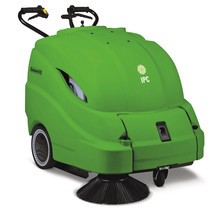 | |
| Suitable surfaces |
|
|
| Types of dirt |
|
|
| Sweeping width (without side brush) | 400–1,000 mm |
900 mm |
| Dirt tank capacity | 15–50 l |
Up to 65 l |
| Area cleaning performance | Up to 3,500 m²/h |
Up to 3,500 m²/h |
| Brush rollers | ✔ | ✔ |
| Side rollers | ✔ | ✔ |
| Brush roller and side brush combination | ✔ | ✔ |
| Suction function | × | ✔ |
| Net weight | 12.5–18.5 kg |
Up to 143 kg |
| Advantages |
|
|
| Disadvantages |
|
|
| Conclusion |
|
|
Please note: Manual sweepers from our range must never be used to sweep up burning objects (e.g. still-burning cigarette ashes), explosive and/or flammable as well as corrosive liquids, or solid debris soaked in these liquids. Carcinogenic dusts and other substances harmful to health must also not be removed with the manual sweepers.
3. How to find the best hand sweeper for you
Different surfaces need different hand sweepers. Not every hand-held sweeper is suitable for removing certain types of dirt. You should therefore carefully define your requirements and the external conditions before purchasing a hand-held sweeper.
Our five-point list can help you find a suitable sweeper:
- What quantities of dirt and what types of dirt do you want to remove?
- How large is the area that you need to clean?
- Do you want to clean indoor areas or outdoor areas?
- How often will the manual push sweeper be used?
- What working width is needed?
Substrates and types of dirt
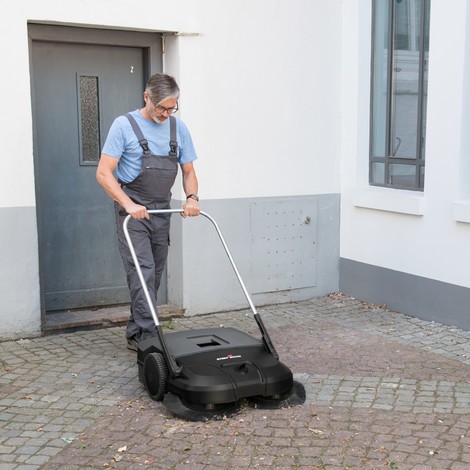
You can use a manual walk behind sweeper from our range to clean smooth and even concreate, asphalt and stone floors, as well as tiles and carpeting.
This means that our versatile sweepers can be used in warehouses and offices, for example, or potentially on outdoor surfaces and paths.
For very large areas such as warehouses or on uneven paths, a battery-powered manual sweeper is most practical, as you can adjust the height of the sweeping system.
At Jungheinrich PROFISHOP you can get industrial push sweepers for areas with a light to moderately heavy degree of soiling. These sweepers allow you to quickly and easily remove:
- Dust and crumbs
- Sand and dry substrate
- Pebbles and small stones
- Cigarette butts
- Leaves, acorns, chestnuts, etc.
With some versions of the electrically powered models, you can even remove moderate amounts of snow or wet leaves.
Performance
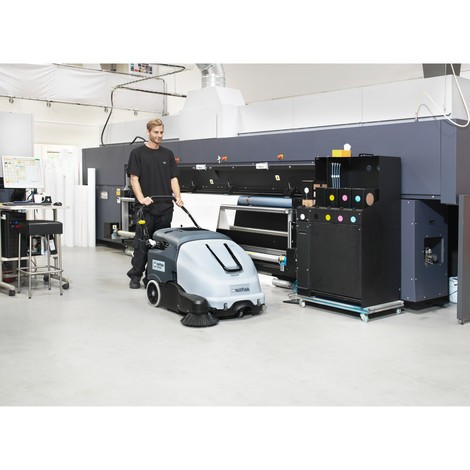
The performance of a hand sweeper is determined by different features:
- Area to be cleaned: The area cleaning performance (theoretical sweeping capacity) indicates how many square metres can be cleaned per hour at a consistent working speed. Depending on the equipment and drive type, our manual sweepers can handle an area of up to 3,500 m²/h.
- Sweeping width: The sweeping width of the manual sweeper determines how wide an area can be cleared of dirt in a single pass. This ranges from 400mm to 1,000 mm for medium-sized and electrically powered manual sweepers with two side brushes. In general, models with side disc brooms have the largest working width.
- Dirt bin size: The performance of the manual sweeper is also determined by the size of the dirt collection container. In addition, some of our models are equipped with a second collection container. This allows dirt to be swept up even when moving backwards.
Roller system / sweeping system
The manual sweepers available at Jungheinrich PROFISHOP are equipped with a specific sweeping system depending on the model. Depending on how the brooms and rollers are arranged in the respective system, they pick up coarse and fine dirt, as well as wet or dry particles:
| Sweeping system | Details | Application |
|---|---|---|
Disc broom system 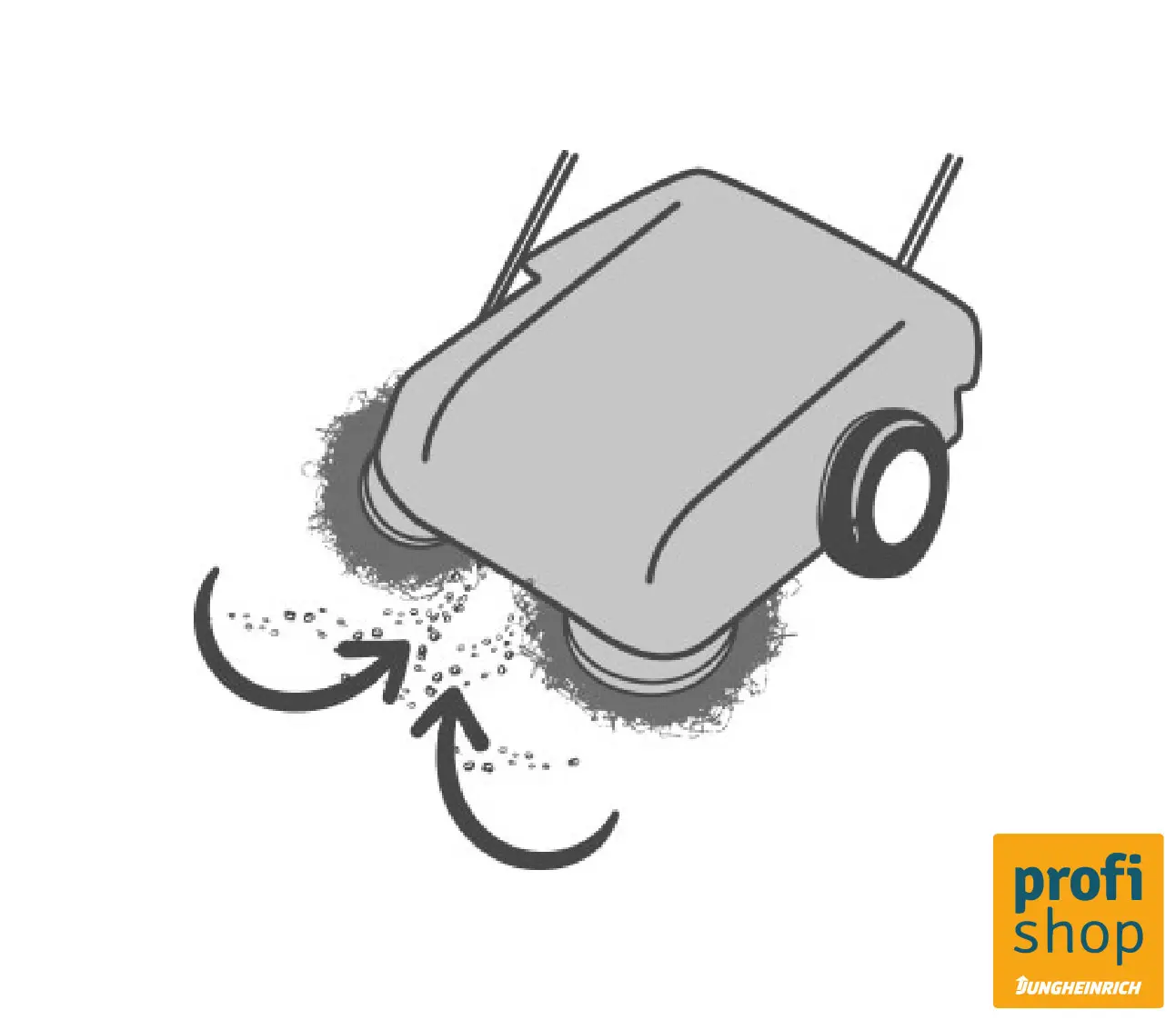
|
|
|
Single roller system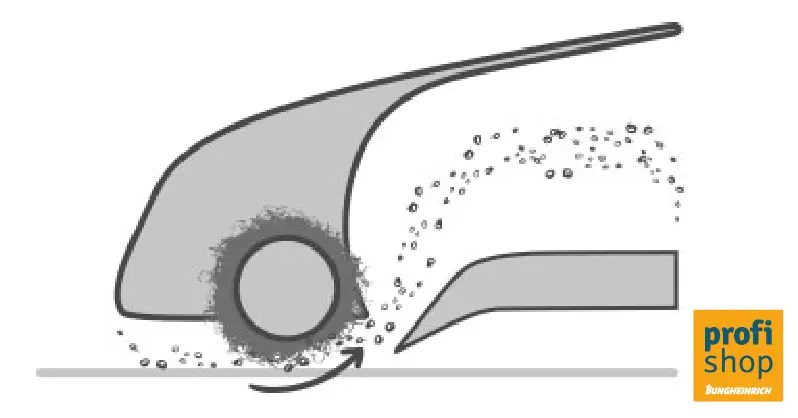
|
|
|
Double roller system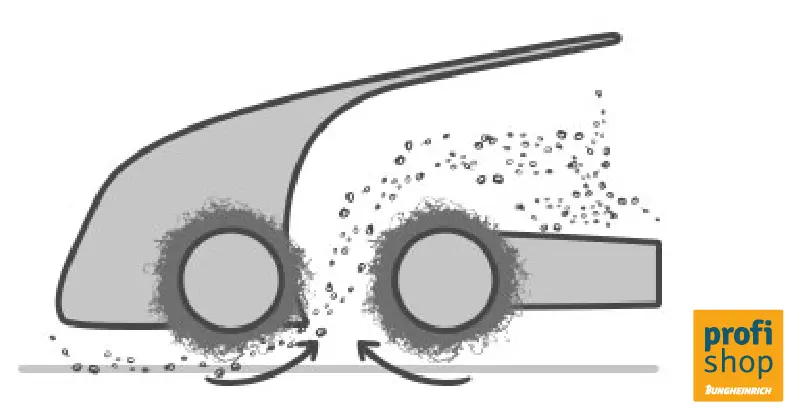
|
|
|
Turbo or tandem system 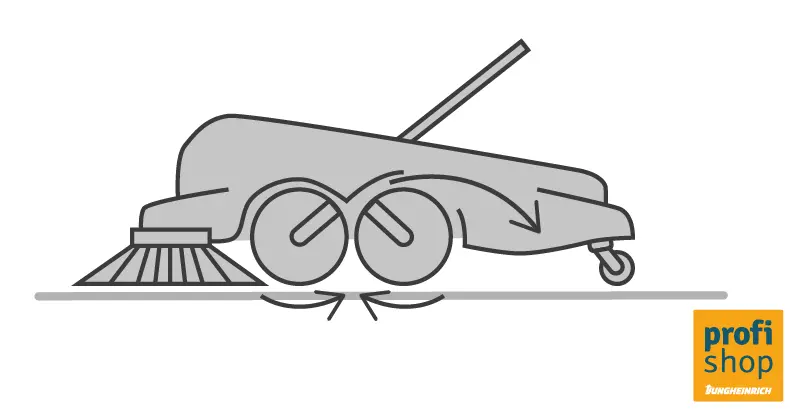
|
|
|
4. FAQ for hand sweepers
Manual sweepers are moved by hand using muscle power, with the user pushing them via a handle.
With a manual sweeper, the brush rollers and disc brooms built into the device are mechanically driven by a pushing motion. With battery-powered models, the brush rotation is powered by an electric motor. The dirt is transported to the centre of the manual sweeper by means of inward-rotating motion and guided into the collection container via a dustpan-like rubber lip.
To achieve the best cleaning results with a hand sweeper, your walking speed should be between three and five km/h. This ensures that the sweeping rollers or disc brooms rotate at the correct speed and all dirt particles are reliably captured by the sweeping system. This cleaning speed also minimises dust dispersion.
After you have finished the work cycle, you should also make sure that the brush roller and disc brooms, as well as the collection container, are clean and not stuck together. If necessary, you can rinse the parts with water and a suitable cleaning agent.
For safety reasons, a manual sweeper should never be used to sweep up flammable, harmful or corrosive liquids or solids. When removing glass, metal or sharp-edged debris from the dirt collection container, sturdy work gloves or cut-resistant gloves are recommended.
A manually operated sweeper cleans areas between 1,200 and 3,500 m² per hour. The devices can be used on flat surfaces, including:
- Asphalt and concrete floors, such as pavements or roads
- Paved driveways and yards
- Tiles, hard floors, and indoor carpets
Some models of hand sweepers can also pick up damp or wet dirt to a limited extent. In most cases, a medium-sized professional manual sweeper or a battery-powered manual sweeper is suitable for this purpose. Models with a disc broom sweeping system are also good for cleaning wet leaves.
A battery-powered manual sweeper is charged via an external charging cable or an integrated or external charger. To do this, the cleaning device must be connected to a 230-volt socket. Depending on the model or battery type, the charging process can take between 30 minutes and 24 hours.
Purchasing a battery-powered manual sweeper is worthwhile for areas of 1,000 m² or larger. If you would like to benefit from maximum operating comfort during cleaning, or if you plan on using it regularly, a battery-powered model can also be practical for smaller areas.
Battery-powered manual sweepers require regular recharging after use. Both electric and manual models also need routine emptying and cleaning of the collection container. For optimal performance, heavily soiled sweeping brooms and brush rollers should be cleaned periodically – on most devices, these can be removed and reattached without tools.