


- For wet and dry dirt
- Robust construction with beltless drive
- Handy container lock
8 Working days

- For wet and dry dirt
- Robust construction with low-maintenance operation
- Handy container lock
8 Working days

- For wet and dry dirt
- Robust construction with beltless drive
- Height-adjustable handlebar with soft grip
8 Working days

- Large 60 l dirt container
- Cleaning performance 2,880 m²/h
- Polyester filter, waterproof
9 Working days

- Battery or petrol variant
- Large 60 l dirt container with handle and transport rollers
- Cleaning performance 3,715 m²/h
9 Working days

- For professional floor and carpet cleaning
- Highly manoeuvrable (185 cm radius)
- Highly productive (5,860 m²/h)
13 Working days

- Hydraulic high discharge (1,420 mm) for convenient handling
- High cleaning performance (7,800 m²/h)
- Large debris container (67 l)
13 Working days

- High cleaning performance (7,475 m²/h)
- Large debris container (60 l)
- Easy to use thanks to intuitive control panel and maintenance menu
13 Working days

- 3-stage SweepSmart™ system for dry dust control and optimal indoor air quality
- High machine performance for reliable cleaning indoors and outdoors
- Ergo Space operator's cab for better view and fatigue-free operation
65 Working days

- SweepMax™ dust control system for better indoor air quality and longer sweeping
- "All levers forward" control – for easy training and operation
- ShakeMax™ filter shaker loosens dust in the filter for extended operating times
65 Working days

- Comfortable, suspended operator's seat with power steering and adjustable steering wheel
- High-performance dust collection and solid steel construction for demanding tasks
- Highly productive thanks to wide cleaning path
65 Working days
Thoroughly clean indoor or outdoor surfaces with an industrial sweeper
A powerful industrial sweeper allows you to remove dirt from large indoor or outdoor surfaces quickly and effectively. Whether you need a warehouse floor sweeper or a machine for outdoor areas, our buying guide will help you discover which model is best suited to your needs.
- What is an industrial sweeper and how does it work?
- Which industrial sweeper is the best?
- How to choose the right industrial sweeper
- Selection based on surfaces and types of dirt to be cleaned
- Determining the drive type and operation of the industrial sweeper
- Buying an industrial sweeper with sufficient capacity and sweeping width
- Choosing the right sweeping system
- FAQ about industrial sweepers
1. What is an industrial sweeper and how does it work?
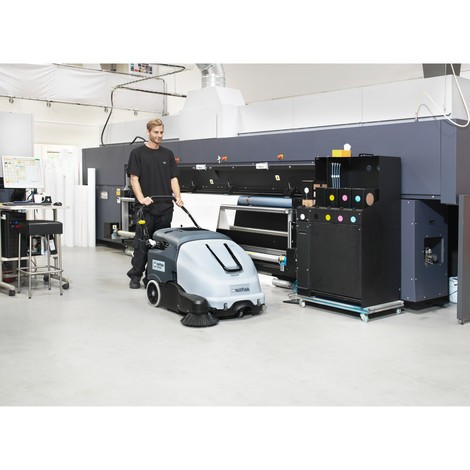
An industrial sweeper is used wherever large areas need to be cleaned or substantial amounts of dirt need to be removed.
Industrial floor sweepers clean the same area five to ten times faster than with a broom – and without any physical effort.
An industrial sweeper is equipped with a dirt tank in which it gathers everything that it sweeps up. A powerful motor drives the fan mechanically or hydraulically, creating a vacuum which sucks small and large dirt particles as well as liquids into the collection container – like with a vacuum cleaner. For this reason, industrial sweepers are also referred to as vacuum sweepers.
In addition, rotating brushes and brooms, usually located on the sides or underneath the industrial floor sweeper, sweep the dirt towards the suction opening or onto the coarse debris conveyor. From here, the dirt and debris are transported into the collection container. An automatic or semi-automatic filter cleaning system regularly clears the filters, preventing blockages.
Besides fast and effortlessly cleaning surfaces of any size, a professional industrial sweeper offers further advantages:
- The bristles of the rotating brushes clean edges and awkward areas thoroughly.
- Some models can also be used indoors as a warehouse floor sweeper.
- Thanks to ergonomic push handles and low weight, these machines can be used without straining the back.
- Some models can be folded up and stored in a space-saving manner.
2. Which industrial sweeper is the best?
Before you buy an industrial floor sweeper, it is worth comparing the different models and their advantages and disadvantages. The following table shows a comparison of our industrial sweepers:
| Properties / sweeper type | Manual sweepers | Ride-on sweepers |
|---|---|---|
|
| |
| Drive | Manual, electric (battery-powered) or petrol | Electric (battery-powered) |
| Types of dirt |
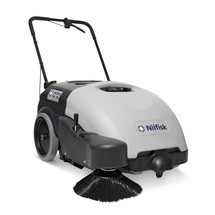
Manual floor sweepers remove fine to medium particles:
|
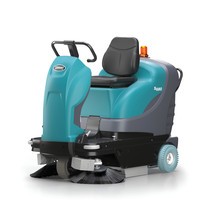
Ride-on sweepers remove fine to large particles:
|
| Surfaces |
|
|
| Max. area cleaning capacity | Up to 3,500 m²/h | 10,000 m²/h |
| Max. sweeping width | Up to 1,000 mm | Up to 2,032 mm |
| Max. dirt tank volume | Up to 65 l | Up to 850 l |
| Indoor use |
× (except petrol-powered models) |
× |
| Outdoor use | × | × |
| Sweeping system: rollers | × | × |
| Sweeping system: rotating brushes | × | × |
| Sweeping system: turbo | × | × |
| Walk-behind operation | × | × |
| Ride-on operation | × | × |
| Sweeper brands | Steinbock®, Tennant®, Nilfisk® | Nilfisk® |
| Advantages |
|
|
| Disadvantages |
|
|
3. How to choose the right industrial sweeper
To make sure you choose the right industrial floor sweeper, use the following checklist to determine your specific needs:
- What types of dirt need to be collected and in what quantities?
- Should the industrial sweeper be used outdoors or indoors?
- How should the floor sweeper machine be powered: manually, electrically, by battery or by petrol?
- How should the industrial floor sweeping machine be operated: with a push handle or as a ride-on model?
- Do you need an entry-level model for occasional use or a professional warehouse floor sweeper for industrial surfaces or daily use?
4. Selection based on surfaces and types of dirt to be cleaned
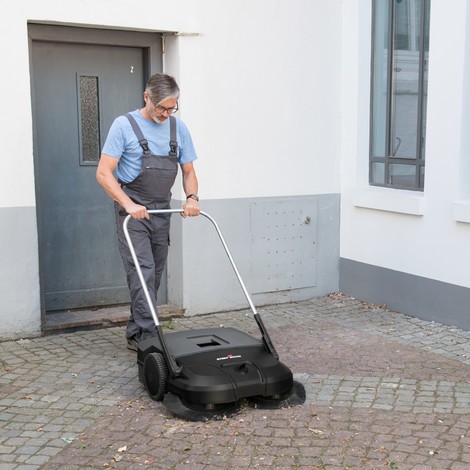
All our industrial sweepers are suitable for cleaning flat surfaces such as asphalt and concrete paths or paving stones.
For rough cobblestones or textured paving slabs, however, we recommend a professional industrial floor sweeper, such as a ride-on model or a powerful walk-behind floor sweeper machine. These sweepers work with particularly strong and variable contact pressure, which removes dirt particles from joints and grooves. The brushes and brooms on these models are also adjustable in height, allowing uneven floors to be cleaned evenly and effectively.
All our industrial sweepers work reliably and versatilely with the types of dirt. They clean indoor and outdoor areas without any problems, removing dust, shavings, small stones, sand or substrates. However, wet leaves, damp or coarse dirt or snow are best removed with a powerful industrial sweeper specifically designed for this purpose, such as a ride-on warehouse floor sweeper. These models can be equipped with rotating double rotating brushes that loosen surface material and transport it into the collection tank.
5. Determining the drive type and operation of the industrial sweeper
At Jungheinrich PROFISHOP, industrial floor sweepers are available in three different drive types and two operating modes. The right choice depends largely on where you'll use the machine: indoors or outdoors.
- For indoor use, you should generally avoid industrial sweepers with combustion engines, unless the rooms are well ventilated. Electrically powered industrial floor sweepers or manual floor sweeper machines are better suited to indoor areas. They will allow you to clean storage facilities or retail spaces emission-free and to manoeuvre safely and effortlessly even in confined spaces, as they have a compact design.
- For cleaning outdoor areas, all industrial floor sweeping machine types are suitable depending on the surfaces, types of dirt and area size. Our ride-on industrial sweepers also excel here with high precision: Despite their size, the robust outdoor machines can be driven with millimetre accuracy along walls or flower bed borders.
Manual drive – walk-behind operation
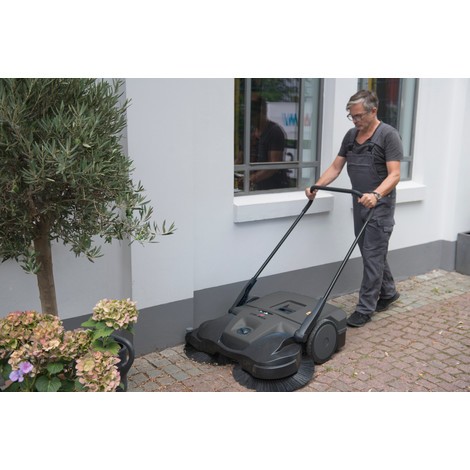
Manual sweepers are equipped either with an ergonomic push handle or a control unit with an ergonomic grip and control panel. A height-adjustable push bar allows for comfortable operation, and the cleaning mechanism, including the rollers and rotating brushes, is activated by muscle power.
The area cleaning capacity of manual sweepers is lower than that of other industrial floor sweepers. However, they are ready for use at any time and take up minimal storage place. This makes them ideal for cleaning small areas or for quick interim cleaning indoors and outdoors.
The ergonomic design suits users of different heights and strengths, enabling comfortable operation even during longer sessions.
Electric drive – walk-behind or ride-on operation
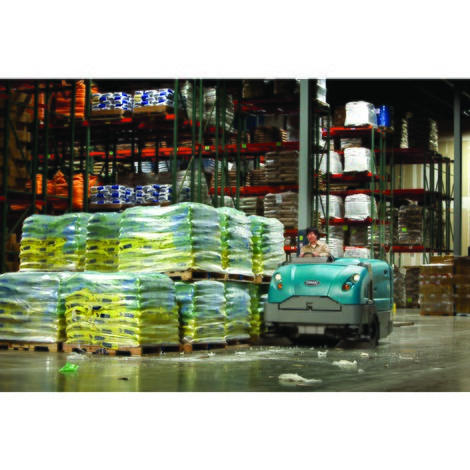
Electric sweepers are powered by a built-in battery, with run times ranging from 0.5 to 5 hours depending on the battery type. After use, the devices need to be charged with an often-integrated charger. Charging times will vary depending on the battery type.
Electric industrial sweepers allow you to work emission-free, making them ideal for indoor use as a warehouse floor sweeper. However, depending on the model and manufacturer, they may also be used outdoors. If you want to clean larger areas regularly, we recommend using a battery-powered industrial sweeper. If you need to use a sweeper continuously (i.e., for extended periods without breaks), be aware that electric models will need to stop for recharging. In this case, models with a combustion engine may be more suitable.
An important quality feature of our electric industrial floor sweepers is their low noise level: This means they can be operated without any problems during office or opening hours.
Electric industrial sweepers are available in the following operating modes:
| Operating mode for electric industrial sweepers | Features and variants in the shop |
|---|---|
| Manual operation |
For medium-sized indoor spaces like offices or corridors, a small or medium-sized battery-powered walk-behind sweeper is ideal. Fine dust filters prevent particles from being released into the air during cleaning. The larger floor sweeper machine models feature large collection containers, making them well suited to industrial and storage facilities where greater volumes of dirt need to be collected. |
| Ride-on operation |
Electric ride-on sweepers deliver the highest cleaning capacity and sweeping width, making them ideal for cleaning large indoor and outdoor spaces. Models with combined sweeping and suction are particularly effective. A clear control panel makes operation straightforward, and most models feature a foot pedal that allows you to adjust brush pressure – useful for uneven floors or gradients of up to 20%, such as ramps. Some models also feature hydraulic overhead emptying, allowing you to drive up to a container and empty the collection basket at the touch of a button. This generally allows you to work more efficiently than with walk-behind machines. To maintain performance, many machines include a filter cleaning function that clears accumulated dust. Some electric industrial sweepers also feature built-in maintenance reminders, including one that alerts you when a service is due. |
Some electric models feature built-in maintenance reminders that alert you when servicing is due.
Please note: Ride-on industrial sweepers capable of speeds over 6 km/h may require a driving licence to operate on public roads. The specific licence category depends on the vehicle's weight and where it will be used. Machines that travel at speeds below 6 km/h typically do not require a driving licence.
Combustion engine drive – walk-behind or ride-on operation
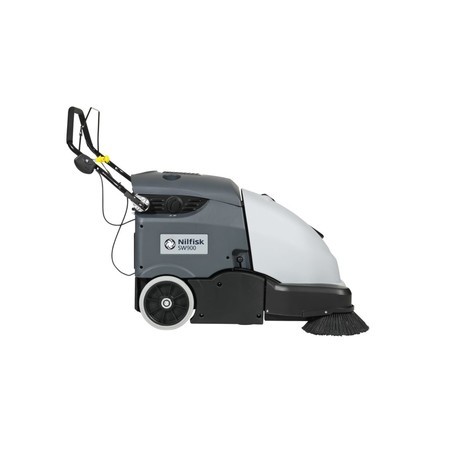
These are the most powerful industrial sweepers in the range, driven by petrol engines that run on standard unleaded petrol. At Jungheinrich PROFISHOP, you can purchase petrol-powered industrial sweepers as walk-behind models or ride-on machines.
With up to five forward gears and one reverse gear, these machines are easy to manoeuvre across different terrain. An automatic stop function also ensures extra workplace safety – the sweeper switches off as soon as the controls are released.
Industrial sweepers with combustion engines are the best choice for regularly cleaning large outdoor areas.
Motor-powered sweepers require regular maintenance due to their complex mechanics. This includes lubricating moving parts and changing the engine oil periodically.
6. Buying an industrial sweeper with sufficient capacity and sweeping width
A sweeper's cleaning capacity indicates how much floor space it can cover, measured in square metres per hour (m²/h).
Cleaning capacity is determined by the dirt tank size, motor power, and sweeping width. Small machines typically offer a sweeping width of around 200 mm, medium models from 600 mm, and large models from 1,000 mm. Side-mounted brushes can extend this further.
| Industrial sweeper type | Area cleaning capacity m²/h |
|---|---|
| Walk-behind industrial floor sweeper |
750–3,500 |
| Ride-on industrial sweeper |
4,000–10,000 |
For comparison: A hand broom has an average area cleaning capacity of around 150 m²/h. The best sweeper for your business depends on the size of the area: the larger the space, the higher the cleaning capacity you'll need.
7. Choosing the right sweeping system
The heart of every industrial sweeper is the sweeping system. At Jungheinrich PROFISHOP, the floor sweeper machines are available with three different sweeping system options:
Roller system:
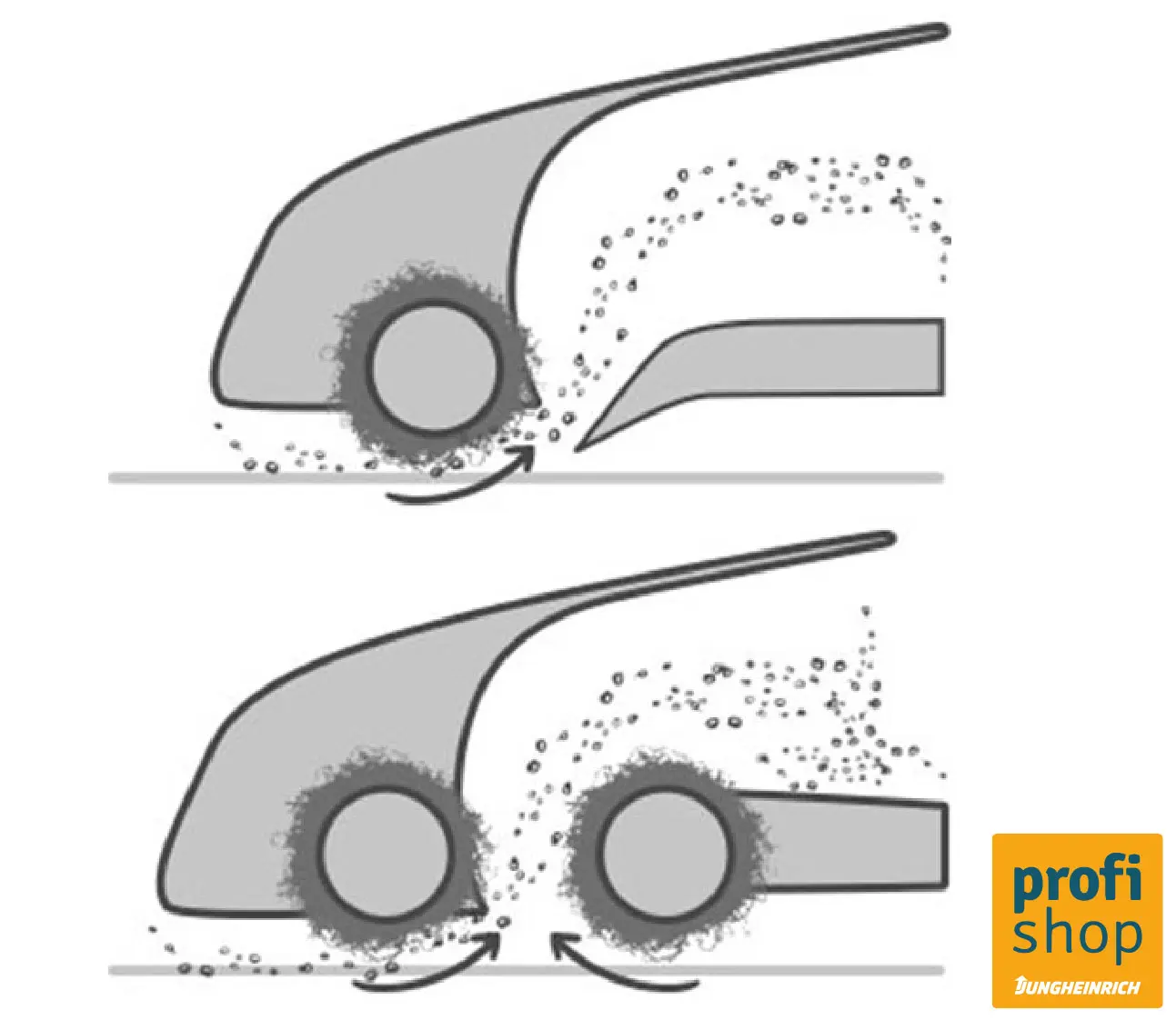
The roller system comes in single and double variants. One or two cylindrical brushes rotate to channel dirt into the adjacent collection container, depending on the given variant.
- Single roller: A rubber wiper blade replaces the second brush, guiding dirt particles into the container.
- Double roller: Two cylindrical brushes rotate in opposite directions, lifting dirt upwards into the collection container.
Rotating brush system:
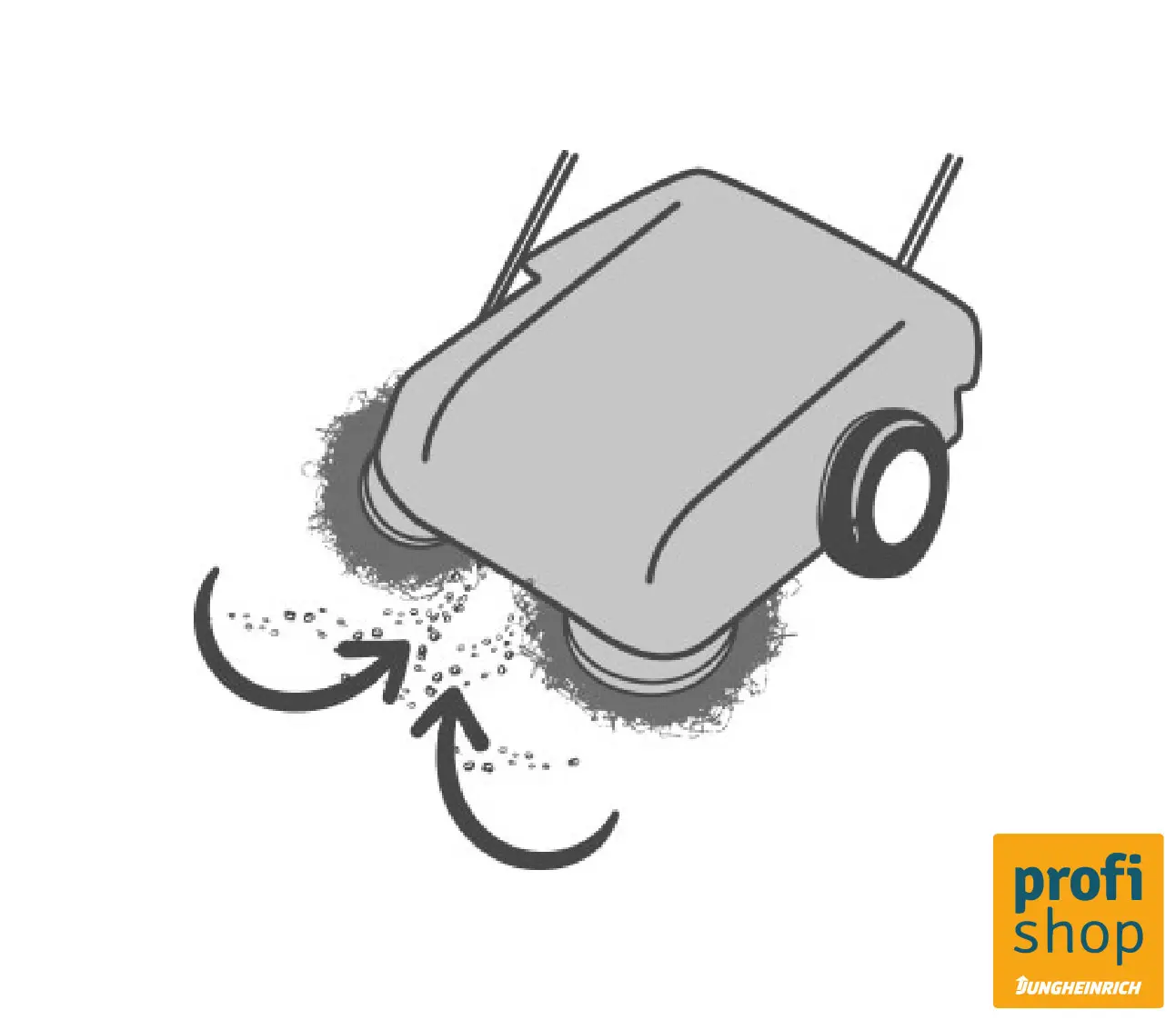
This system uses one or two disc-shaped brushes that sweep dirt particles across a wide area and rotate them into the collection bin. It handles both coarse and wet debris effectively, making it well suited to demanding industrial environments.
Side-mounted rotating brushes allow corners and edges to be cleaned thoroughly, while also extending the machine's overall reach.
Turbo sweeping system:
This system fundamentally combines the operating principles of the roller and rotating brush systems, with two cleaning principles possible depending on the floor sweeper machine model:
- With the overhead principle, the dirt tank is located directly behind the sweeping roller. All dirt is therefore transported from above, over the roller and down into the debris tank.
- With the dustpan principle, the dirt tank is mounted behind the rotating brushes and in front of the brush roller. In this way, all the dirt is swept from below upwards. This allows both heavy and fine dirt to be picked up optimally by the industrial floor sweeper.
FAQ for Sweepers
Yes, if you regularly need to clean indoor and outdoor areas, an industrial sweeper is worth it. These machines clean five to ten times faster than manual sweeping, saving time and energy.
In commercial and industrial settings, electric or petrol-powered sweepers with high cleaning capacity deliver the best results. A manual floor sweeper machine is most suitable for regular cleaning in private properties, garages and front gardens.
The main difference between an industrial sweeper and a scrubber-dryer is their cleaning functions.
- Industrial sweepers collect dry debris ranging from fine dust to coarse particles. Models with a suction function can also vacuum up the material. With adjustable brush pressure and various sweeping systems, they're ideal for outdoor areas and large spaces such as warehouses, workshops, and factory yards.
- Scrubber-dryers, on the other hand, are designed for wet cleaning, predominantly indoors. They scrub the floor using rotating brushes, then vacuum up the dirty water via a suction foot. This makes them ideal for removing stains, spills, and liquids.
No, weed removal is not possible with an industrial floor sweeper. At most, depending on the model and brush contact pressure, an industrial sweeper can brush off light wild plant growth like moss between stepping stones.
For thorough weed removal, choose a weed remover that uses rotating wire brushes or a gas burner function.
An industrial sweeper with height-adjustable brush rollers and rotating brushes is ideal for uneven surfaces. It cleans at varying height levels and uneven surfaces evenly and effectively.
It depends on the machine's speed and where you use it. Sweepers with a top speed under 6 km/h generally don't require a driving licence. For faster models used on public roads, a licence may be required. The category depends on the vehicle's weight. On private premises, licensing requirements are typically less strict.
Most councils permit the use of power equipment on weekdays between 7 a.m. and 7 p.m., with more limited hours at weekends. Some low-noise models may be permitted outside these times. Check your local council's guidelines for specific restrictions in your area.