
Table of contents
In logistics, industrial goods are usually loaded on pallets for safe, space-efficient handling and transport. To prevent goods from moving during transport, they must be securely fastened. Pallet stretch wrapping allows individual items to be packaged together to create a solid load unit. When done correctly, wrapping pallets can help ensure your goods arrive at their destination undamaged.
In this guide, you will learn which methods and equipment are available, how to wrap pallets correctly, and which regulations apply to pallet wrapping.
What is the purpose of pallet wrapping?
By tightly wrapping goods and pallets with stretch film – known as pallet stretch wrapping – you achieve the following:
- Goods are secured against shifting or tipping through load securing with stretch film
- Compact load units are formed from pallets and goods, which are particularly stable and can withstand even strong forces such as sea swell or winding transport routes
- Goods reach their destination as safely as possible and in better condition
- This reduces unnecessary costs due to complaints and improves customer satisfaction
Preparing and securing your pallets
Before wrapping your pallets, follow these steps and consider using accessories to help with the process:
- Check the pallet quality for damaged boards and missing or protruding nails.
- Stack the goods correctly: Heavy goods go on the bottom of the pallet, lighter goods on top. Ensure the goods are flush with the pallet edge. For sensitive or unstable products, an intermediate layer of packing paper may be useful.
- Edge protectors can protect sensitive packaging and prevent the stretch film from being damaged by goods with sharp edges. Protective corners can stabilise the packaging unit for very heavy goods.
- If the goods need protection from the weather or have special hygiene requirements, cover the top of the goods with a masking film before starting the actual wrapping process. This can also increase the stability of the pack unit on the pallet.
How to wrap a pallet by hand
For manual pallet wrapping, you need the right technique in addition to a hand dispenser and a suitable stretch film. The following instructions show you how to apply the film correctly to secure your goods to the pallet:
- Base wrap
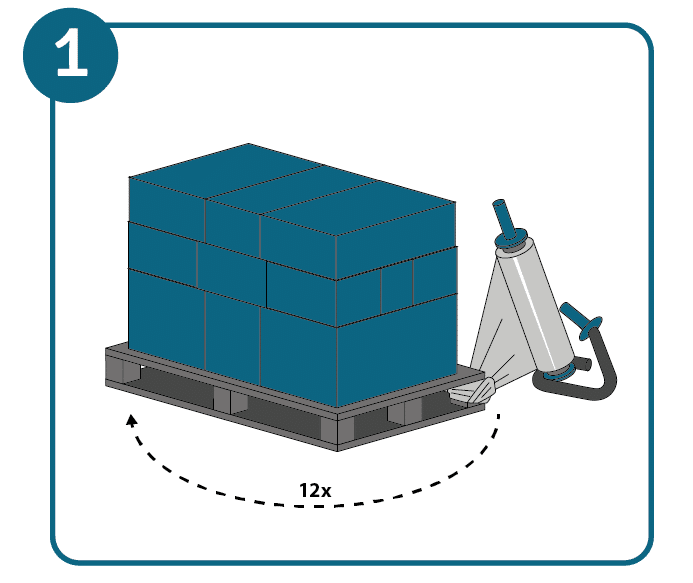 Knot the end of the film at one corner of the pallet. Now wrap the lower area of the goods to securely connect them to the pallet. As a guide:
• Standard goods, stably stacked: 2-3 wraps
• Unstable or light goods: 3-5 wraps
• Heavy loads or export goods: 4-6 wraps - Middle wrap
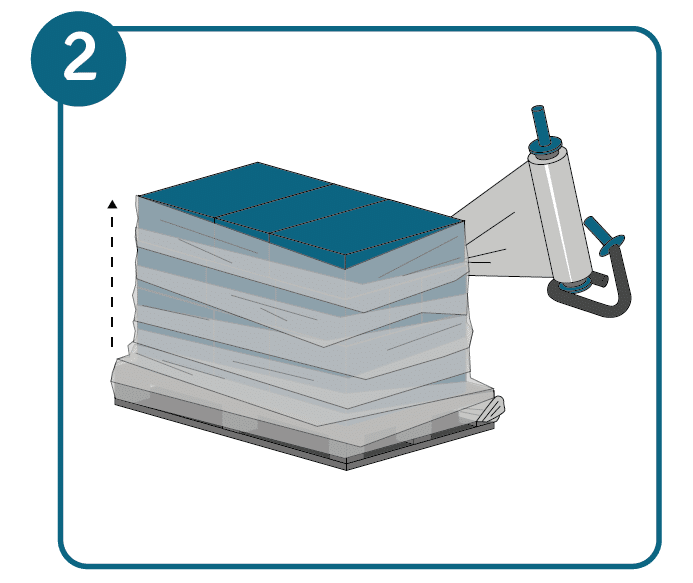 Wrap the stretch film in a spiral around the load units from the base upwards. Each new layer should overlap the last one at least halfway.
 - Head wrap
 Once you reach the top of the load, wrap it four or five times. It’s important not to pull too tightly here, so the film doesn’t tear or crush the goods. As a guide:
• Normal securing for stable goods: 2 wraps
• Protection against shifting or weather: 2-3 wraps
• Combined with cover film: 2-4 wraps - Cross wrap
 Stretch downwards again in a spiral. This will ensure the middle area is doubly secured. You should also wrap the base area again.
Special care must be taken when wrapping the base as this is one of the biggest potential structural weaknesses. Make sure that the base is secured with a sufficient number of wraps so that the load unit can be transported with floor conveyors and the goods cannot shift from the pallets even after loading.
Important information about stretch film used for wrapping pallets
Stretch films are flexible, stable, and lightweight materials that are usually transparent, though coloured options are also available. They come in three main types: mini stretch films, hand stretch films, and machine stretch films, differing in thickness (μm), load capacity, and size.
All films are made of plastic polythene (PE), which is liquefied to produce various types of films. The quality of the PE depends on its molecular structure and is crucial for the film’s load capacity.
You should consider two factors when choosing the right stretch film:
- Select a film that’s suitable for your cargo type and weight
- Apply the film using the correct technique
Regardless of the quality, each stretch film must be pre-stretched to its limit to securely fasten your goods. Only when this limit is reached can it withstand high inertial forces. Before then, the material may give way even under slight force and is unsuitable for safely transporting boxes, crates or loose goods.
The right hand stretch film for manual pallet wrapping
For manual pallet wrapping, you can use standard films or pre-stretched film. However, pre-stretched films are typically recommended, as they offer the following advantages:
- Roll weight: A roll of standard film weighs approximately 4 kg including hand dispenser, while a roll of pre-stretched film weighs approximately 2 kg with dispenser. This makes manually wrapping pallets with pre-stretched film easier.
- Material thickness: Standard film is relatively thick compared to pre-stretched film – you need more storage space for standard film.
- Material consumption: Wrapping pallets with pre-stretch film requires approximately 60% less material. Wrapping a pallet nine times with standard film requires about 300 g of standard film, or approximately 120 g with pre-stretched film.
- Cost: Due to the higher material consumption, the cost of standard film is about 33% higher than pre-stretched film.
Use pre-stretched films for load securing. They are particularly important for working with a manual dispenser or a simple stretching machine without a pre-stretching function, as manual pallet wrapping cannot guarantee that the consolidation limit is reached.
Please note: Applying the wrap by hand is mainly suited to protecting cargo from dust, dirt, and moisture. A pallet stretching machine, on the other hand, is more suited to securing goods for safe transport.
Wrapping pallets: Tips for operating pallet wrapper machines
Both automatic and manual pallet wrapping require the right technique. If you are using a pallet stretching machine, it is particularly important that you configure the system correctly. You should consider the following steps:
- Set the stretch ratio of the stretch film
- Calculate the optimal application tension
- Set the number of base, middle and head wraps
What types of pallet stretching machines are there?
If you want to apply films automatically to a load, the following pallet wrappers may be suitable:
| System | How it works | Advantages |
|---|---|---|
| Systems with brake roller | • The stretch film first runs over an electro-mechanical brake roller – this ensures a constant tension • The tensioned film is wrapped around the loaded pallet on the turntable • Recommended for pre-stretched films | • Simple technology, no electronics required • Pre-stretch to approximately 50-70% • Robust and low-maintenance • Ideal for simple applications and low wrapping volumes |
| Pre-stretching systems without drive | • Suitable for non-pre-stretched films • Consists of two rollers that pre-stretch the film • The tension of the film during wrapping corresponds exactly to the degree of pre-stretching | • Pre-stretch up to 100-150% • Constant stretch (depending on the wrapping) • Better stretch than brake rollers |
| Pre-stretching system with drive | • Two or more motor-driven rollers with different speeds • The stretching force for wrapping can be set higher than the pre-stretch • Only suitable for particularly high-quality films | • Highest efficiency and control • Pre-stretch is adjustable and reproducible • Lowest load consumption • Best load securing through constant restoring force • Ideal for high volumes and sensitive goods |
FAQ for wrapping pallets
Businesses often wonder whether stretch wrapping pallets is a valid way to safely transport and store goods. The short answer is yes. The load can only slip or become damaged if mistakes are made during stretching. To transport goods safely with the help of stretch film and to determine who is responsible for securing the load, the following guidelines and standards should be followed:
• BS EN 415-8: This standard deals with safety requirements for automatic packaging machines including, but not limited to, machine design, installation, operation, maintenance, and cleaning.
• Pallet Safety PM15: This guidance covers general-purpose flat pallets and includes practical advice to industries and companies that regularly use pallets for storage and transport. Included is a recommendation that shrink-wrapping be used to secure pallets where the height exceeds the longest base dimensions of the pallet.
• EU Directive 2014/47/EU: The directive stipulates that “all actors involved in the logistics process […] must ensure that the cargo is properly packed and properly loaded onto a suitable vehicle” (paragraph 17). This is checked during technical road inspections by competent authorities and applies to any vehicle operating within the EU, regardless of country of origin. In the UK, DVSA officers perform a similar role and have the power to inspect commercial vehicles for health and safety compliance.
If you apply standard films by hand, it is unlikely you will be able to uniformly achieve the optimal level of tension. This means that manually applied, non-pre-stretched films can expand during transport and cause goods to slip. Pre-stretched film makes manual wrapping simple by arriving at the optimal level of stretch.
You can achieve the greatest stability with a pallet stretching machine, as it stretches the film immediately during application and therefore develops the necessary tensile forces to secure the load. Manual pallet stretching is typically used more to protect against dust, dirt, and moisture than to secure the goods.
Please note: The regulations mentioned above represent only a selection of the most important legal requirements. Please refer to the listed organisations and directives for more detailed information. If in any doubt, consult experts or contact the relevant regulatory authorities.
Image source:
© gettyimages.de – dolgachov, endopack