Set Jungheinrich PROFISHOP as your preferred source to find our articles more easily in the future.
Table of contents
Efficiently organising goods shipping is one of the core tasks in logistics. This includes planning delivery times and routes, as well as choosing the right means of transport. To work out whether a Sprinter van suits your needs, you need to know exactly how much it can carry, including what a Mercedes Sprinter’s internal dimensions actually are. This guide answers how many pallets fit in a Sprinter van and shows you how to work out pallet spaces for various Sprinter and pallet types yourself.
Transporting pallets with a Sprinter
Sprinter vans are by far the most widely used transport vehicles in regional freight. They are compact and have a high payload, which makes them ideal for short and medium-length delivery routes. 3.5-tonne Sprinter vans are faster and more manoeuvrable than a lorry or a truck, and smaller volumes of goods are needed to make full use of their capacity. Because of this, they’re mainly used to transport individual items, such as parcels or furniture; however, loading them with pallets works just as well.
So, how many pallets fit in a 3.5-tonne van? There’s no universal answer, as a Sprinter van’s pallet capacity depends on two factors:
- Vehicle type: How large is the Sprinter’s load area?
- Pallet size: What are the dimensions of the pallets you’re transporting?
Sprinter vans are available both as small vans with a gross vehicle weight of up to 3.5 tonnes, driveable on a standard car (Category B) licence, and in heavier-duty configurations exceeding 3.5 tonnes GVW that require a Category C1 licence. Since both vehicle and pallet sizes vary so much, it’s usually easier to calculate pallet spaces by starting from whichever one is already fixed – either the vehicle you have, or the pallet type you need to use.
Once you have the measurements, you can work out which vehicle best suits a particular delivery, or which pallets make the most of a given Sprinter model’s capacity. This allows you to align your intralogistics processes perfectly with your goods transport.
Pallet types for transporting goods
Euro pallets are used almost exclusively for regional goods transport. The most common type, standardised by EPAL (the “European Pallet Association”) under the designation EUR1 (Euro1 pallet), measures 1200 x 800 x 144 mm (length x width x height). These dimensions have shaped the wider industry: pallet accessories, the shelf depth of industrial shelving and the fork length of a pallet truck, are all designed around them. Even transport vehicles have adapted to fit. The loading door of the Mercedes Sprinter, for instance, was widened from the second generation onwards so that Euro pallets could also be loaded crosswise.
Euro pallets come in other sizes too, though these are used less often. The table below shows the most common standardised Euro pallets and their dimensions:
| Pallet | Dimensions (length x width x height in mm) | Base area in m² | Weight in kg | Load capacity in kg |
|---|---|---|---|---|
| EUR1 (Euro1 pallet) | 1200 x 800 x 144 | 0.96 | 25 | 1500 |
| EUR2 (Euro2 pallet) | 1200 x 1000 x 162 | 1.2 | 35 | 1250 |
| EUR3 (Euro3 pallet) | 1000 x 1200 x 144 | 1.2 | 30 | 1500 |
| EUR6 (Euro6 pallet, “half pallet”) | 800 x 600 x 144 | 0.48 | 9.5 | 500 |
Industrial pallets (also known as UK standard pallets) are also quite common. At 1200 x 1000 x 150 mm, they’re wider than a Euro pallet and are the default choice for domestic UK distribution, retail, and warehousing, where they’re often favoured over Euro pallets for their larger footprint. They’re also frequently used in mechanical engineering and industrial production for transporting oversized single items or large quantities of goods.
There are other pallet types too, though they don’t play significant roles in regional freight transport. Container pallets are one example, sized specifically to create as many pallet spaces in a container as possible, however they aren’t relevant for small vans.
Different Sprinter models and their number of pallet spaces
There is also a wide range of Sprinters. Every model is available in a range of sizes and payloads, with a variety of engine and transmission options, from small vans to curtain-sided models and box vans.
The table below shows the most common Sprinter models and how many pallet spaces they offer, giving you an instant answer to how many Euro pallets fit in a Sprinter van.
| Sprinter model | Maße (Länge, Breite, Höhe in m) | Nutzlast in kg | Anzahl der Stellplätze für Europaletten EUR1 |
|---|---|---|---|
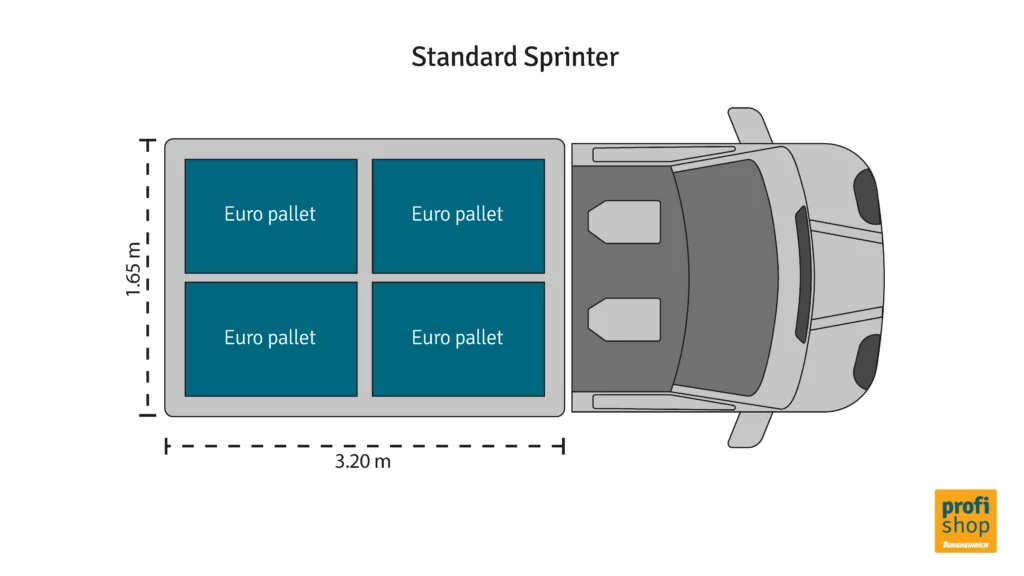
| Standard | 3.20 x 1.65 x 1.75 | 1200 | 4 |
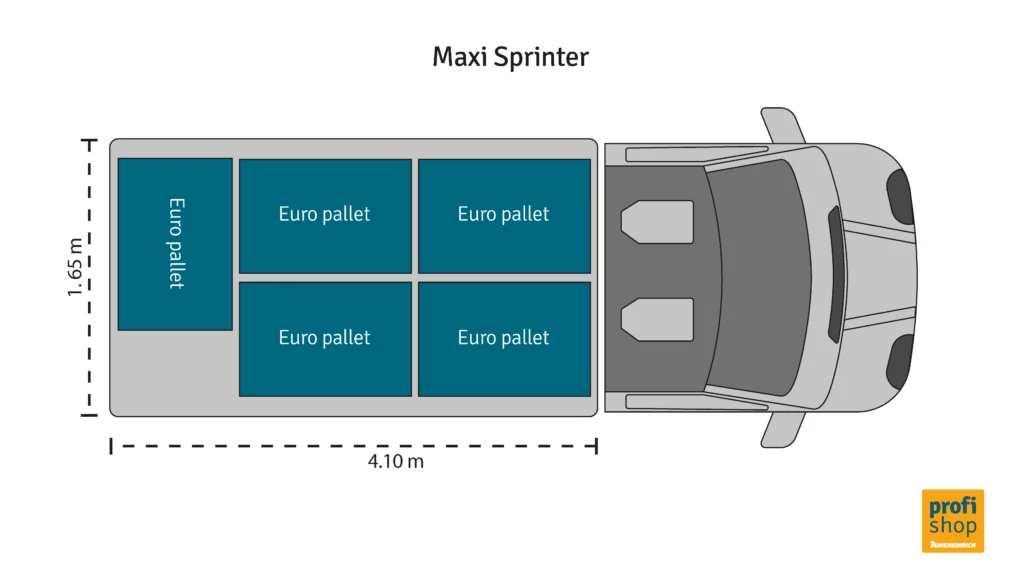
| Maxi | 4.10 x 1.65 x 1.75 | 1150 | 5 |
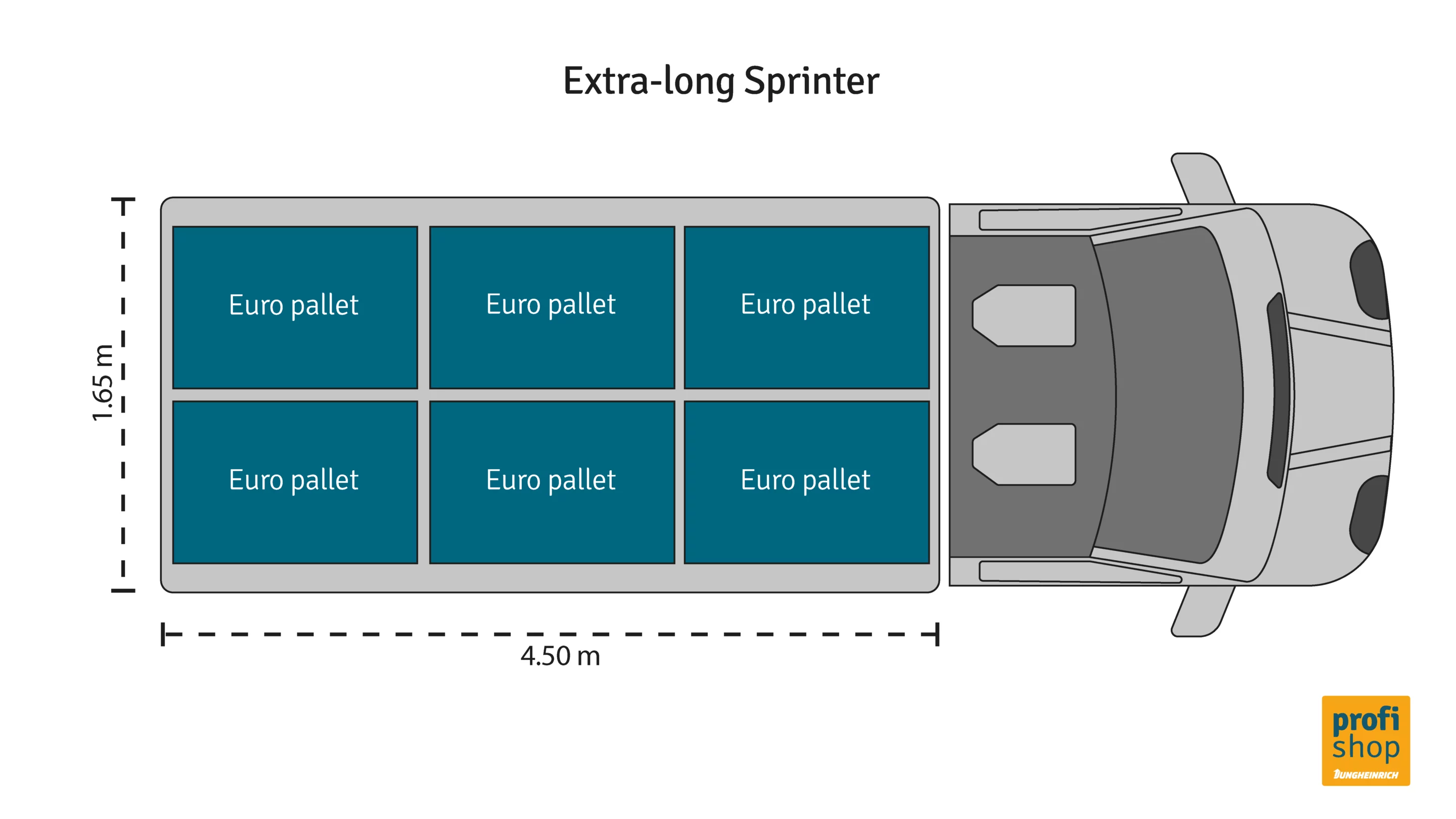
| Extra-long | 4.50 x 1.65 x 1.75 | 1100 | 6 |
| Box body | 4.20 x 2.10 x 2.10 | 800 | 8 |
Note: In practice, wheel arches can slightly reduce the actual number of pallets that fit in a Sprinter, particularly in box-type vans. For example, despite a theoretical capacity of 6 pallets, the Maxi Sprinter can often only fit 5 lengthwise. What’s more, a Sprinter with a gross vehicle weight of 3500 kg and an unladen weight of 2500-2800 kg only has a payload of around 700-1000 kg. To stay within this limit, each pallet should weigh no more than 140-200 kg.
If you don’t have enough goods for a full pallet, you can fill the remaining space with items like roll containers or Euro crates. If you’re loading the Sprinter with pallets, here are some example loading plans (these don’t account for wheel arches or other load area restrictions caused by vehicle fittings):
How to calculate pallet spaces in a Sprinter
Vans with special bodywork, such as a box body or refrigerated body, often have dimensions that differ from the standard. The same applies if you want to load industrial pallets or pallets that don’t match the standard size. In these cases, you can easily calculate the number of pallet spaces using a few simple formulas.
Note: For safety reasons, you can’t stack pallets in the transport vehicle, so you can only use the floor space of the load area.
Trucks are usually a standard 2.45 m wide, fitting 3 Euro pallets lengthwise or 2 crosswise per row, so calculating pallet spaces in a truck is normally quite straightforward. However, Sprinter widths vary more, so working out the number of available pallet spaces for them takes one extra step. For a Sprinter, first work out how many pallets fit side by side across the width, then work out how many fit lengthwise. Finally, multiply both results together to get the maximum number of available pallet spaces.
This is illustrated by the example of a refrigerated Sprinter. The interior measures 3.32 m long, 1.87 m wide and 1.92 m high.
Formulas:
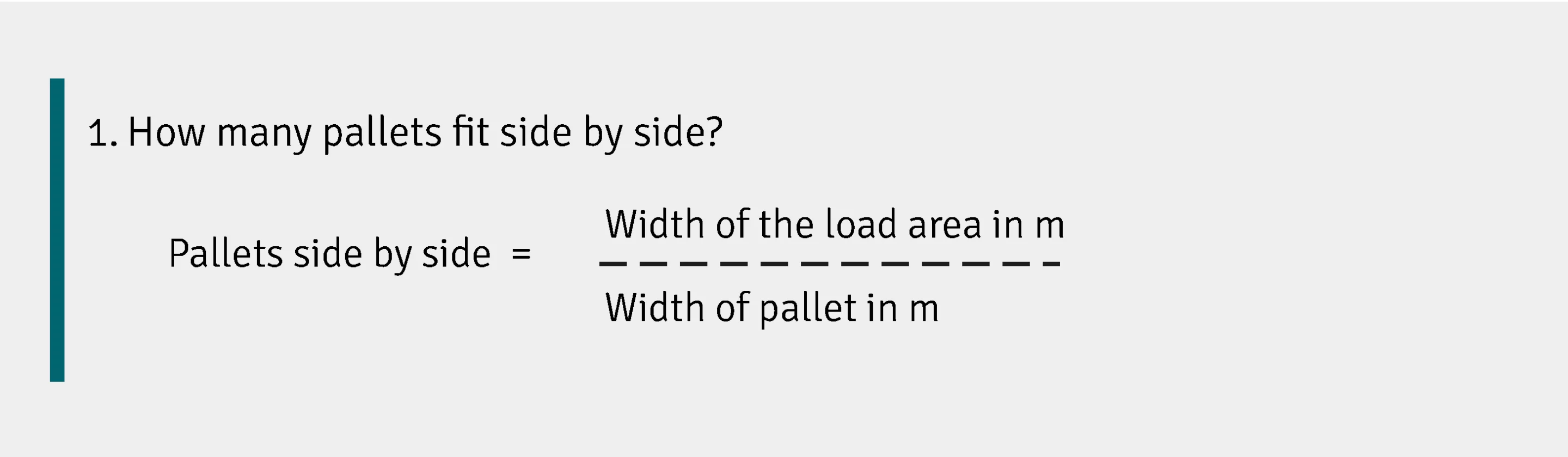
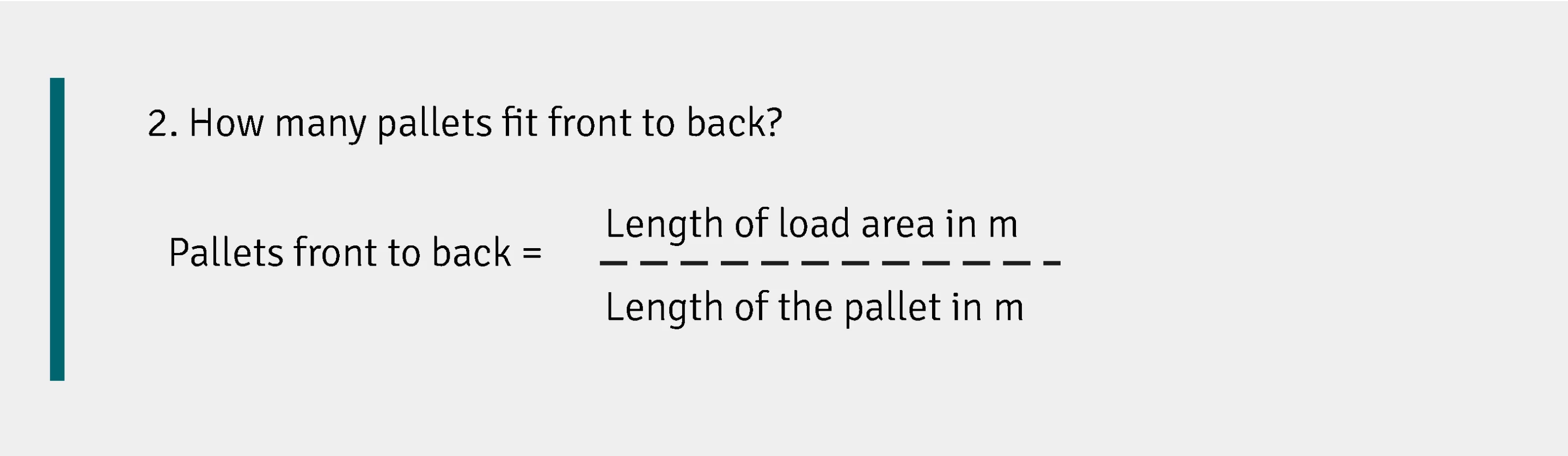
3. How many pallets fit into a Sprinter in total?
Pallet spaces = pallets side by side x pallets front to back
Example:
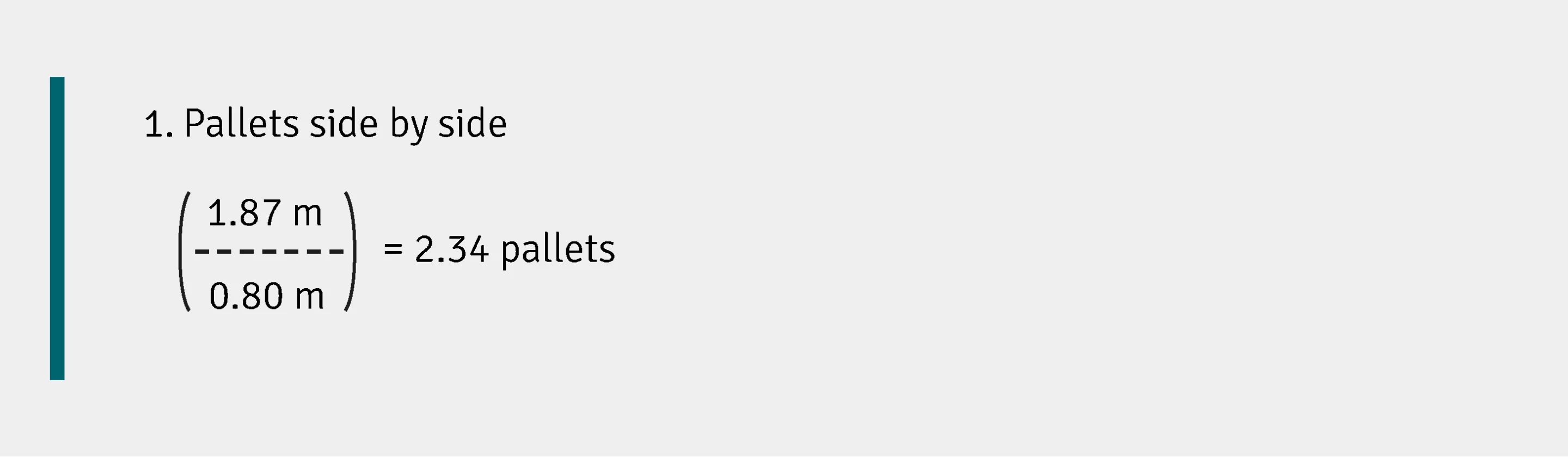
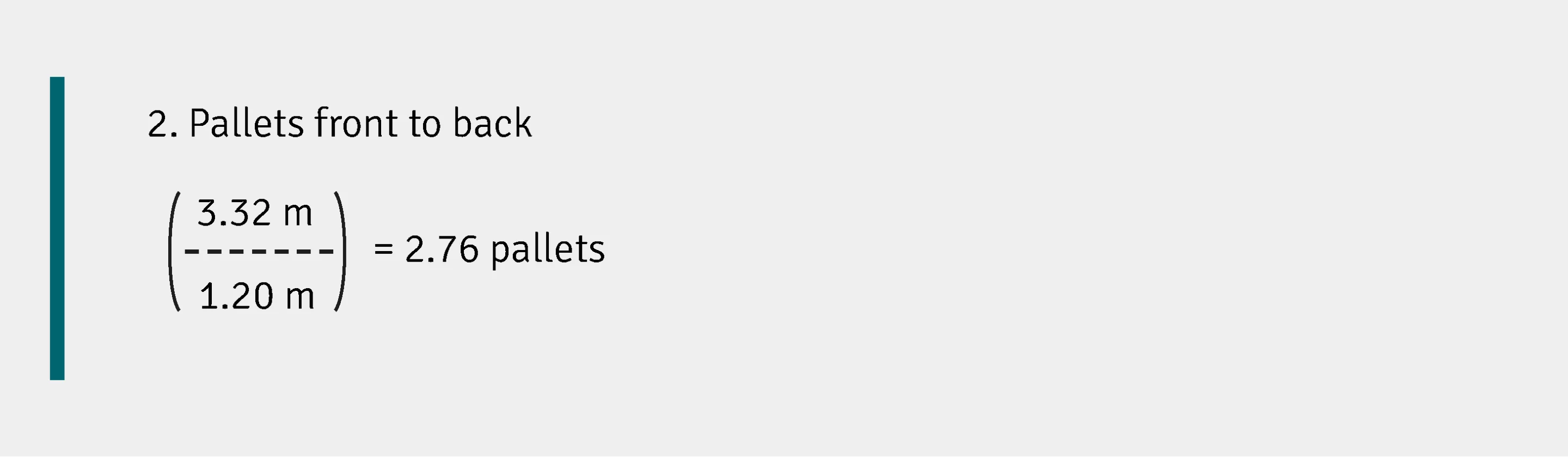
Both results are rounded down, since you can only load whole pallets.
3. Pallet spaces in a Sprinter
2 x 2 = 4 pallets
You can apply these calculations to any load area and pallet size. If you want to check whether loading the pallets crosswise makes more sense, adjust the formulas accordingly: divide the load area’s width by the pallet’s length, and its length by the pallet’s width.
Taking weight distribution into account in a Sprinter
When creating a loading plan for a Sprinter, don’t just think about making the best use of the load area, but also about how the load’s weight is distributed. Every vehicle has a specified maximum payload and permitted axle loads that must not be exceeded, and you can only make full use of these limits if the weight is spread as evenly as possible across the load area.
This is set out in the Road Traffic Act 1988, the Road Vehicles (Construction and Use) Regulations 1986, and health and safety legislation under the Health and Safety at Work etc. Act 1974. Their purpose is to keep vehicles roadworthy and help prevent accidents caused by improper loading, whether on the road or in the workplace. Uneven weight distribution shifts the vehicle’s centre of gravity, which affects handling and braking, and in the worst case can lead to vehicle damage or accidents. You’ll find practical guidance on load securing in the DVSA’s securing loads on HGVs and goods vehicles guide.
Loading a Sprinter with pallets
Once you’ve worked out how many pallets fit in the Sprinter, it’s time to put that into practice. To make the most of your available pallet spaces, plan every step carefully, from loading the pallets to securing the load, and tailor each one to your vehicle’s specifications.
- Loading pallets with goods
Match your palletising process to the goods you’re transporting. Small items may need extra packaging to stack well, while a large batch of uniform items can often go straight from the picking trolley onto the pallet. Since you can’t stack pallets in a Sprinter, make the most of each pallet’s space and load capacity.
- Securing the load on the pallet
Once all the goods are on the pallet, secure them for transport so they don’t slide off or get damaged by other goods in the vehicle. Air cushioning and foam protect pressure-sensitive items, while stretch film or straps keep the load in place on the pallet. Take care not to change the pallet’s dimensions when securing the load, or you may not fit as many pallets into the load area as you calculated.
- Loading the Sprinter
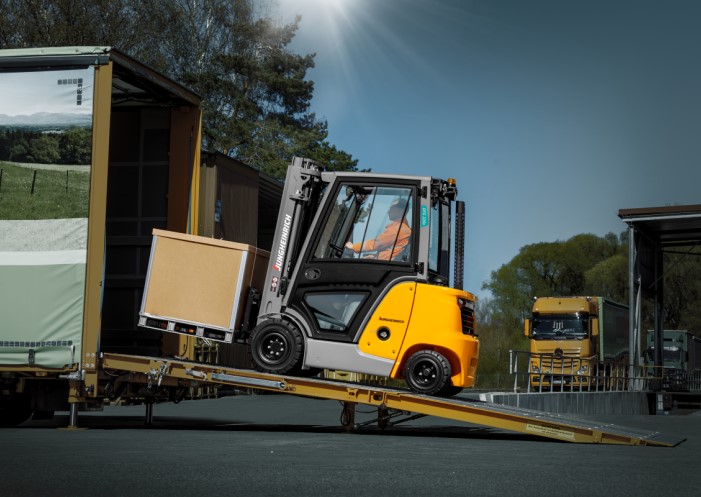
Once secured, the pallets are moved to the loading area with a forklift truck and loaded into the Sprinter with a pallet truck. Position the pallets at the loading ramp in the right orientation and order beforehand to save time when loading the Sprinter.
- Making the best use of storage space
Your loading plan should already reflect the optimal use of the Sprinter’s load area and an even weight distribution. This plan is now essential. It shows warehouse staff how to arrange the pallets and, if needed, how to fill any remaining space with additional goods.
- Securing the load in the Sprinter
Once all the pallets are in the Sprinter, secure them again so they can’t move around – even during sudden braking or sharp bends. Lashing straps and ropes fastened to the anchor points on the Sprinter’s walls are perfect for this. For loads with big differences in size and weight, you can fit partition walls to add extra stability and prevent transport damage.
FAQ for how many pallets fit in a Sprinter van
There’s no single answer, as the number of pallet spaces in a Sprinter depends on two factors:
• The type and dimensions of the pallet
• The size of the Sprinter’s load area
Depending on the model, a Sprinter can carry up to eight Euro pallets. The standard Sprinter, at 3.20 m long and 1.65 m wide, fits up to four.
If the load area is big enough, you can mix pallets of different sizes. Quarter or half Euro-size pallets are best for loading with as few gaps as possible. Just make sure there are no large gaps and that every pallet is properly secured before transport.
Image source:
© gettyimages.de – Georgijevic