

Set Jungheinrich PROFISHOP as your preferred source to find our articles more easily in the future.
Table of contents
An important task in logistics is finding the right transport method for shipping goods and raw materials while making the best possible use of the available space. If you transport goods in containers, it’s important to know the number of pallet spaces available for efficient planning. So how many pallets fit in a container, and how do different container and pallet sizes affect loading? This guide has all the answers.
What determines how many pallets fit in a container?
The question of how many pallets fit in a container is more complex than it may first appear, and there is no straightforward answer. Just like how many pallets fit in a truck, it depends primarily on the type of pallet used and the dimensions of the loading space.
Before answering “how many pallets fit in a container?”, consider a few other questions:
- Which pallets do you want to use to transport your goods, and what are their dimensions?
- Which type of container will you use for transport, and what are its interior dimensions?
The answers matter for more than just the container’s loading plan. They’re also essential for organising your intralogistics, particularly the goods-outbound process where items are packed and loaded. They let you determine the right container for a given type and quantity of pallets, and which pallets make the best use of a specific container’s interior space. In day-to-day operations, this is key to keeping logistics costs down without affecting order processing, delivery times or vehicle utilisation.
Pallets and containers in international freight transport
Before working out how many pallets fit in a container, it helps to have an overview of which pallets and containers are available to you. The design and dimensions of common pallets and containers are internationally standardised, which makes choosing the right handling equipment such as pallet trucks and pallet accessories much easier.
Choosing pallets
The dominant standard in freight transport is the Euro pallet, standardised by EPAL (the European Pallet Association) as EUR1. Its dimensions of 1,200 x 800 x 144 mm (length x width x height) set the benchmark for most vehicles and handling equipment, as well as storage solutions such as industrial shelving and transport or storage tanks. It’s the dominant format for European and export freight, which makes it the most relevant standard when it comes to container shipping.
Another pallet widely used in mechanical engineering and manufacturing is the industrial pallet, designated EUR3 by EPAL. At 1,200 x 1,000 x 144 mm, it’s larger than the Euro pallet and is typically used to transport large machine parts and spares. This is the same footprint as the UK standard pallet – the dominant format in UK domestic logistics – though it’s less widely known here under its EPAL EUR3 designation.
Sea freight containers, standardised under ISO 668, follow American measurements, meaning their interior space can’t be fully utilised with Euro or industrial pallets. Special container pallets measuring 1,140 x 1,140 mm (or a fraction of this) offer a solution, since they match international container dimensions exactly.
The table below gives an overview of common pallet types and their dimensions.
| Pallet type | EPAL designation | Length in mm | Width in mm | Height in mm |
|---|---|---|---|---|
| Euro pallet | EUR1 | 1,200 | 800 | 144 |
| Industrial pallet | EUR3 | 1,200 | 1,000 | 144 |
| Container pallet F11 | CP3 | 1,140 | 1,140 | 130 |
| Container pallet F76 | CP5 | 1,140 | 760 | 130 |
Choosing containers
ISO containers are the most widely used type for overseas transport. Because they’re standardised, they can be transferred straight onto the next vehicle without repacking, which considerably eases logistics at freight ports and rail terminals. Dimensions are given in feet (‘) and inches (“). Standard containers come in two lengths:
- 20-foot containers
- 40-foot containers
Both lengths share the same width of 8′ and height of 8’6″ (2.438 m and 2.591 m respectively).
ISO containers are suitable for ocean-going and inland vessels, as well as road and rail transport. Air freight instead uses special containers known as Unit Load Devices (ULDs), which are angled at the sides, so they fit snugly within an aircraft’s rounded fuselage.
To make loading with Euro pallets easier, so-called inland containers are also used across mainland Europe and on inland waterways. Marked “PW” for “pallet wide”, these have a width of 8’2″ (2.490 m), wide enough to fit two Euro pallets side by side crosswise. Another special case is the HC container, where “HC” stands for “high cube”. These have a height of 9’6″ (2.896 m). Both PW and HC containers are at least 45′ long, and HC containers are also available in 48′ and 53′ lengths.
All the figures above refer to external container dimensions. Bear in mind that internal dimensions are somewhat smaller. The table below shows the average internal dimensions of the most used sea containers:
| Container type | Length in m | Width in m | Height in m | Gross weight in t | Payload in t |
|---|---|---|---|---|---|
| 20‘ container | 5.898 | 2.352 | 2.385 | 30.48 | 21.67 |
| 40‘ container | 12.032 | 2.352 | 2.385 | 30.48 | 26.48 |
| 45‘ PW container | 13.556 | 2.438 | 2.385 | 30.48 | 25.68 |
| 45‘ HC container | 13.556 | 2.352 | 2.698 | 30.48 | 25.44 |
There are numerous other pallet and container designs, but their dimensions tend to be so specific that they’re better suited to one-off orders and special cargo, playing little part in the standardised processes of global sea and air freight.
How to calculate pallet spaces in 20- and 40-foot containers
You don’t have to rely on our calculation tool – pallet spaces can just as easily be worked out using a formula.
With an internal width of 2.352 m, 20- and 40-foot containers are just a touch too narrow to fit two Euro or industrial pallets side by side crosswise. Arranged lengthways, on the other hand, they leave large gaps on one side. If switching to container pallets isn’t practical, you’ll need to work out how best to make use of the available space.
A formula can help you work this out. Depending on which dimensions you compare, it will also tell you whether it’s better to arrange the Euro pallets lengthways or crosswise.
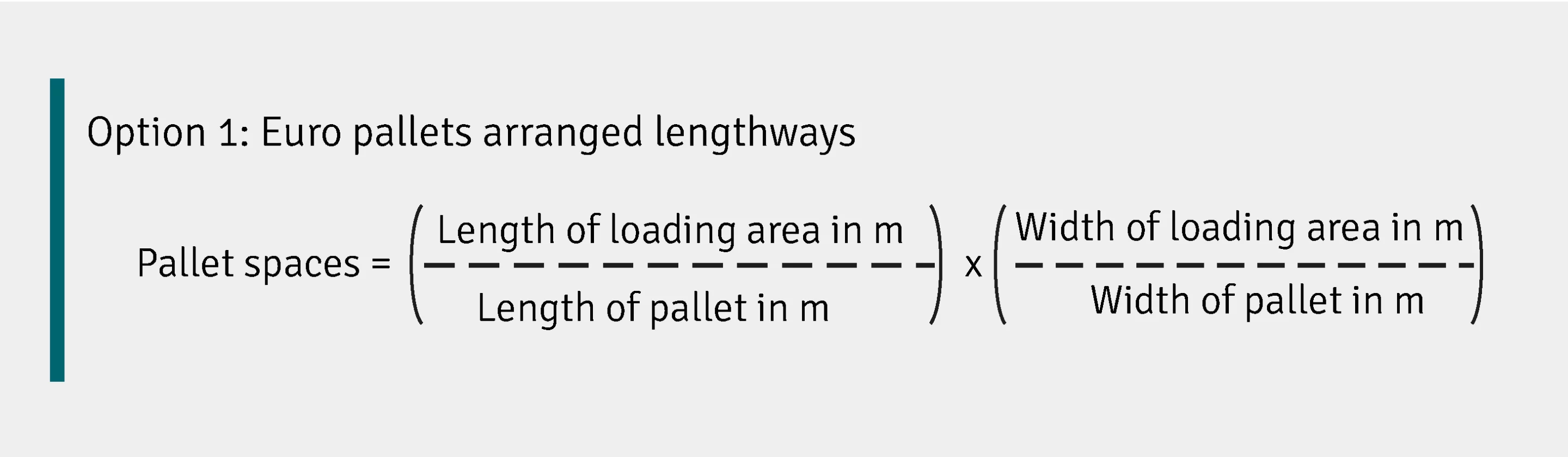
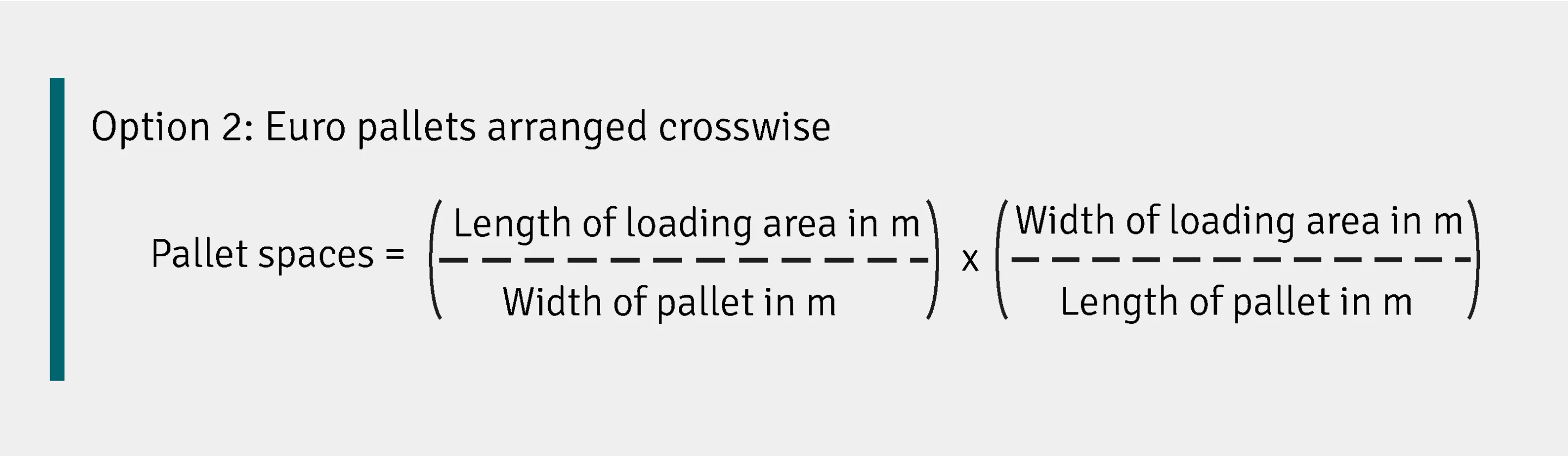
Important: Always round intermediate results down. This is the only way to get an accurate answer, since in practice you can only ever load whole pallets.
Here’s how the calculation works for the question “how many Euro pallets fit in a 40-foot container?“:
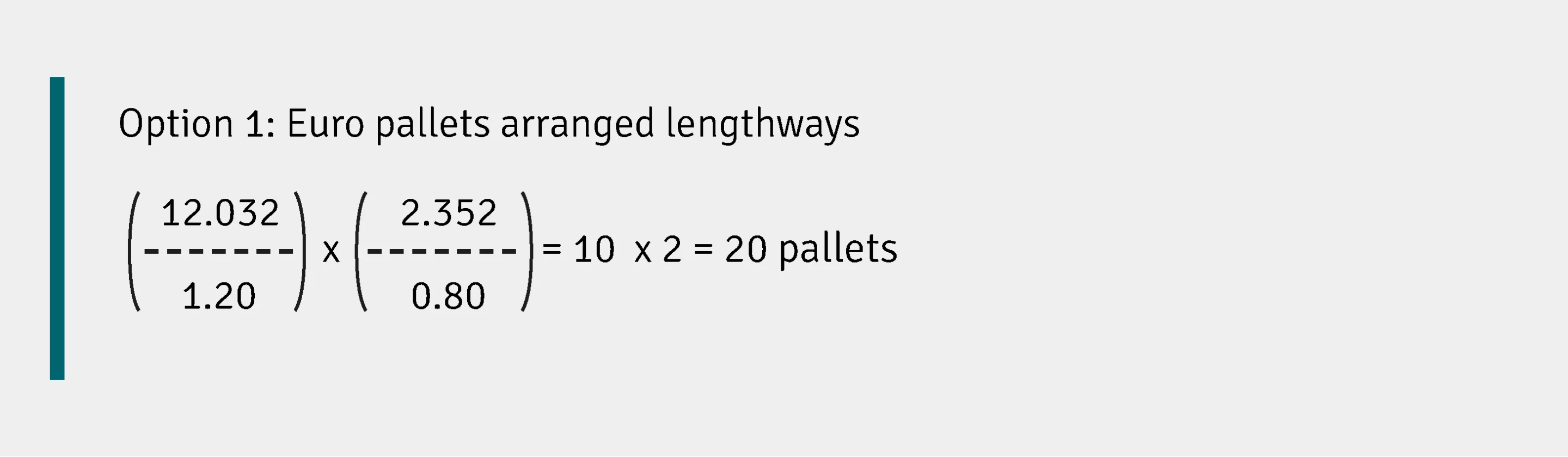
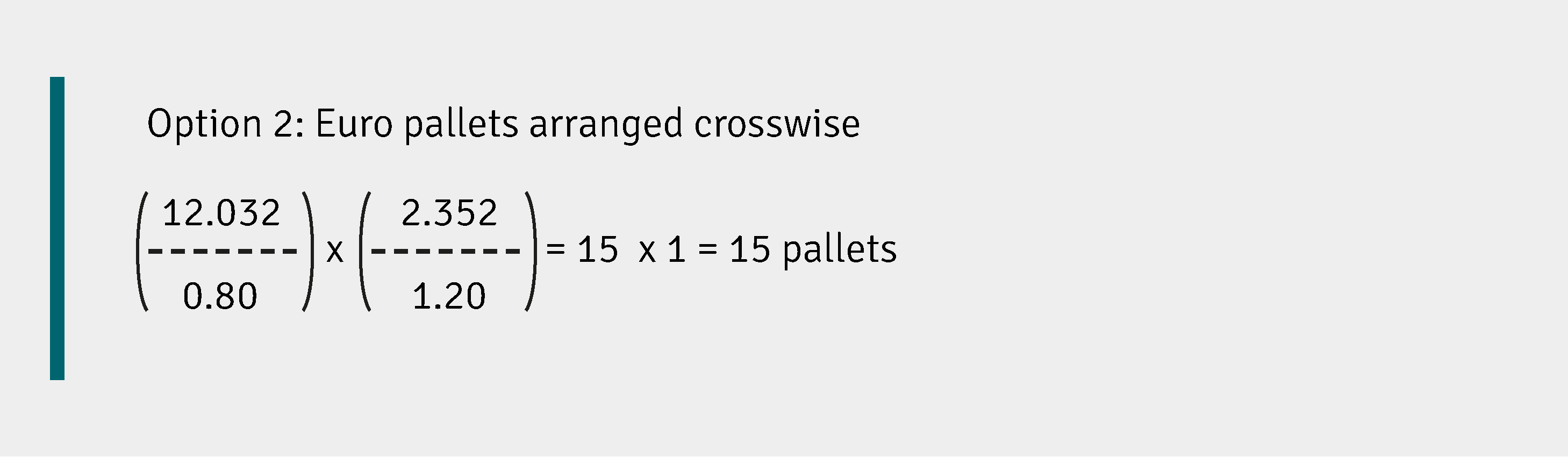
Running the same calculation with the dimensions of container pallets shows how you can optimise the container’s interior space with the right pallet choice. Since the F11 pallet is square, measuring 1.14 m on each side, you only need to calculate one dimension and multiply by two – it’s already clear that two pallets will fit side by side. So how many pallets fit in a 40-foot container when using container pallets?
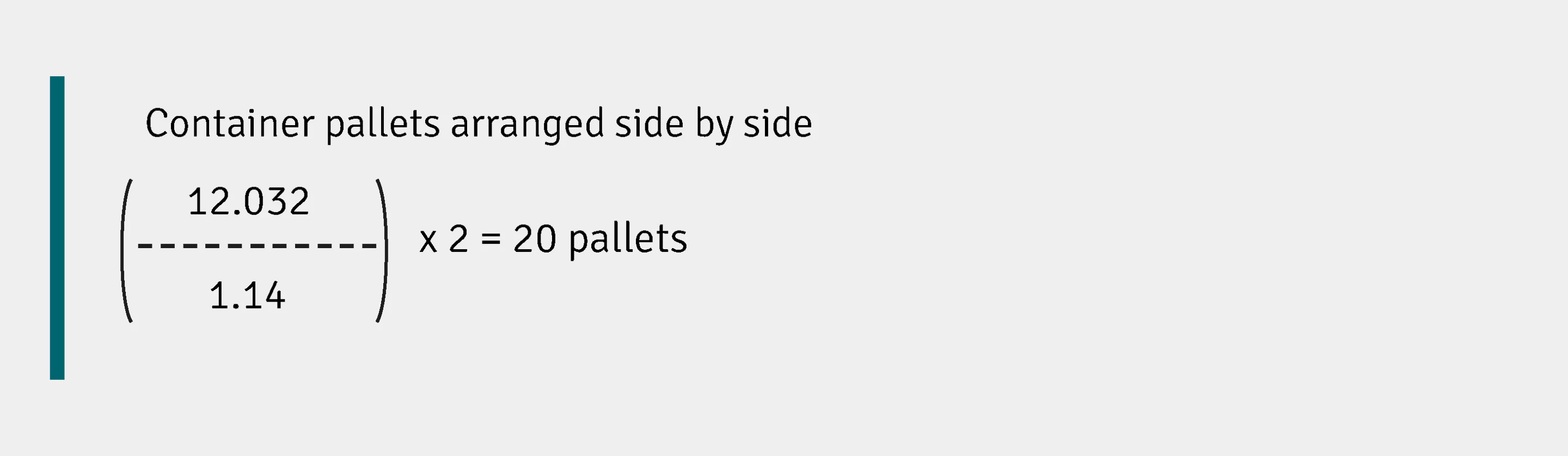
As you can see, a 40′ container offers 20 pallet spaces for Euro or container pallets. Thanks to their larger footprint – 1.2996 m2 compared to 0.96 m2 for the Euro pallet – container pallets not only make better use of the available space but also let you transport more goods overall.
This formula works for any pallet and container size. Here’s one final example, this time with industrial pallets: how many pallets fit in a 20-foot container using this pallet type?
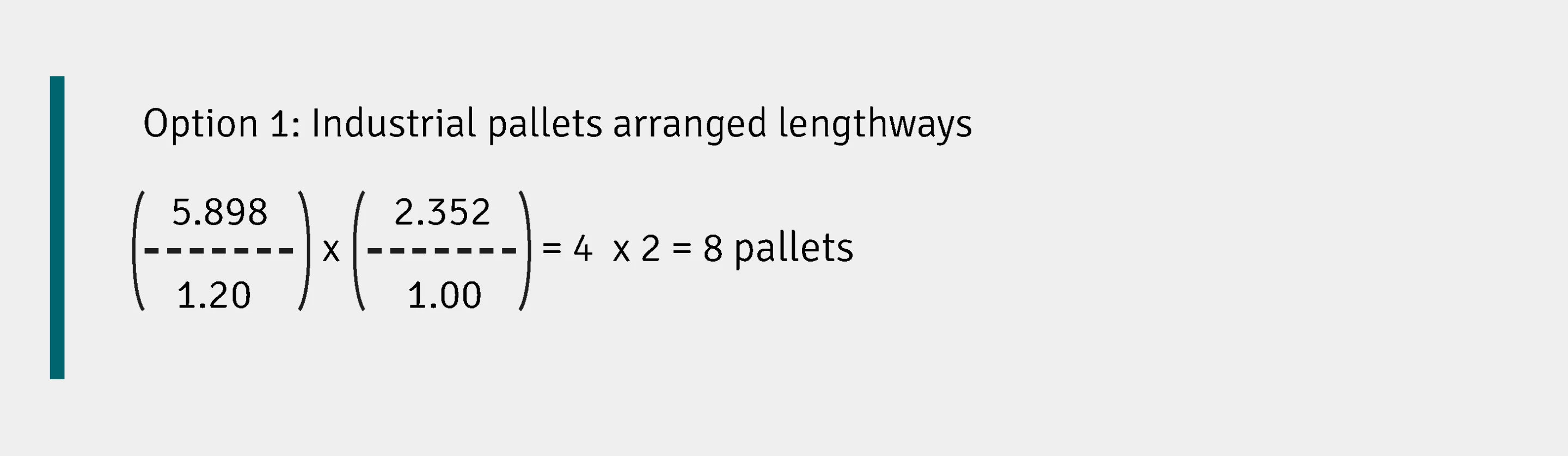
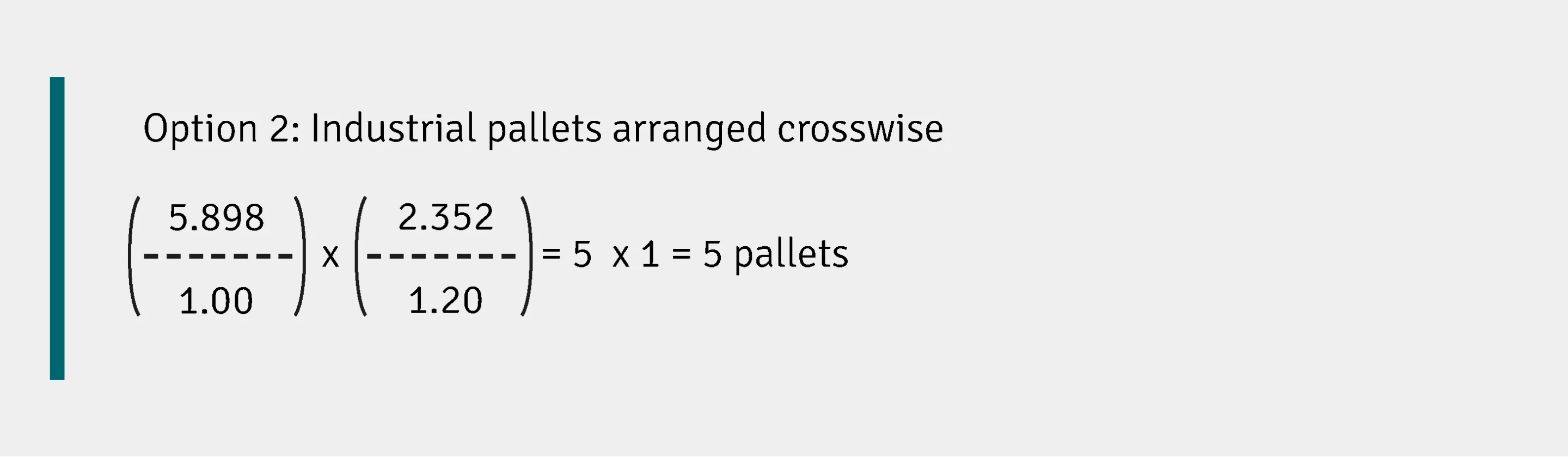
One important caveat: this formula only works if the container is loaded with identical pallets, all facing the same direction. In practice, you can of course mix pallet types and orientations to make the fullest possible use of the loading area.
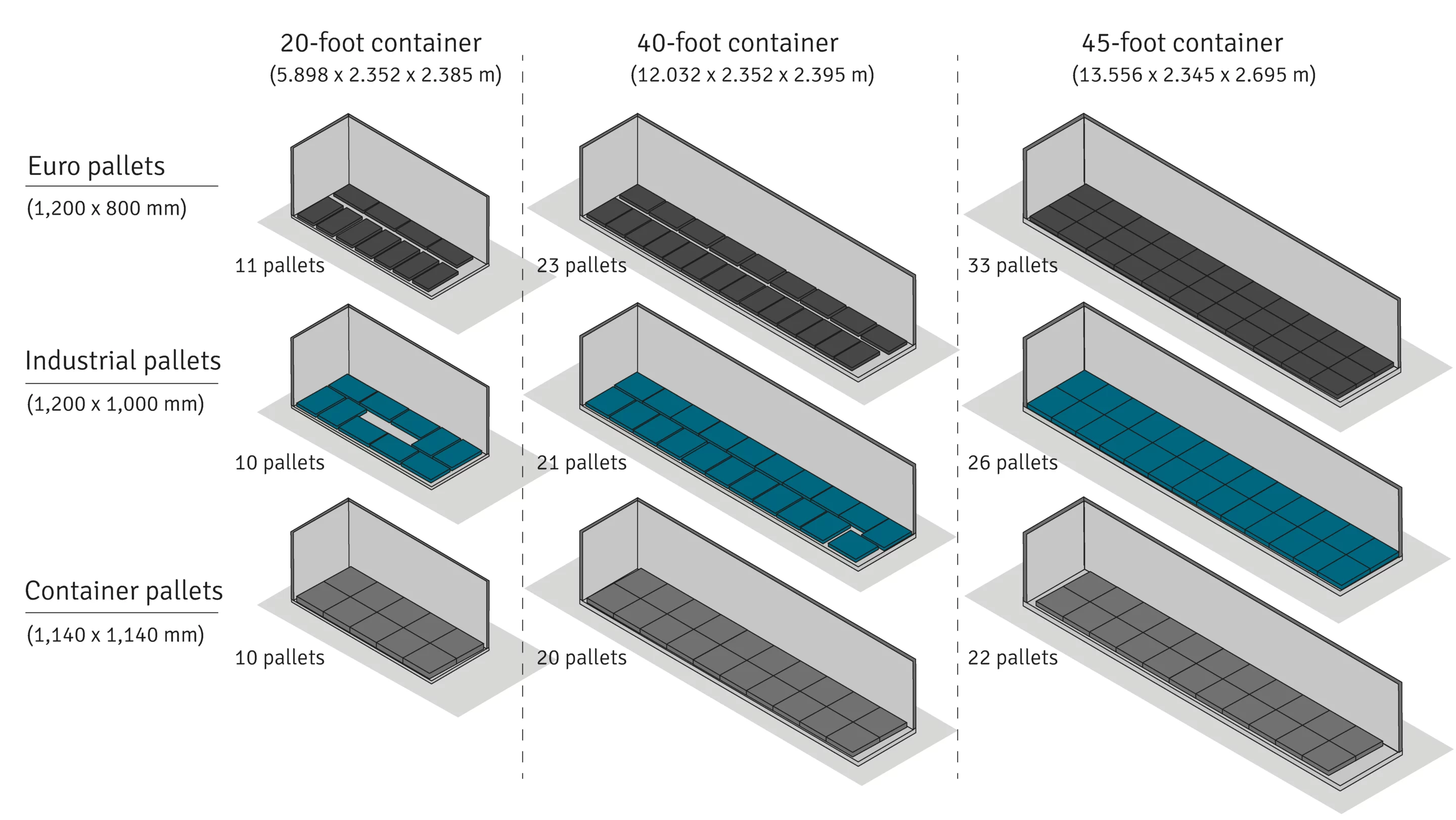
There are simply too many possible combinations to distil into a single universal formula. If you’re planning a loading layout for a container using a mix of pallet types, scale templates or dedicated software are recommended. Here’s what different pallet orientations can look like in practice:
Loading plan for a 20′ container
With an optimised layout, the number of pallets in a container – in this case a 20-foot container loaded with industrial pallets, building on the earlier example – can rise to as many as 10 pallets.
Loading plan for a 40′ container
An offset layout can also affect how many Euro pallets fit in a 40-foot container, potentially raising the maximum from 23 to 24 pallets.
Distributing weight evenly in the container
Alongside making the most of the loading space, you also need to factor in the weight of each pallet when preparing to load a container. This isn’t just about staying within the permissible gross weight – weight distribution across the container matters just as much and is vital for transport and road safety. Unevenly distributed loads can, in the worst case, cause a vehicle to lose control on sharp bends or during emergency braking, or even cause a container to slide off an ocean freighter’s deck in heavy seas.
To prevent incidents like these and keep cargo as safe as possible, the International Maritime Organization (IMO), the International Labour Organization (ILO) and the United Nations Economic Commission for Europe (UNECE) jointly developed the CTU Code. The “Code of Practice for Packing of Cargo Transport Units (CTU)” sets out guidelines for safely packing cargo transport units for transport by water, road and rail. On weight distribution, Chapter 3 (Section 3.3) and Chapter 9 specify that heavy cargo must be spread evenly across the entire floor area, with the load’s centre of gravity kept as central as possible.
When loading a container with pallets of varying weights, it is advisable to plan the weight distribution carefully in advance and record it in the container’s loading plan.
How a container is loaded with pallets
Once you’ve done the maths, you’ll know how many pallets should theoretically fit into a given container. In practice, though, planning errors or loading issues can mean you don’t end up using every available pallet space. The fix is to review and fine-tune each step of the process.
- Loading goods onto pallets
Goods picked in the warehouse are registered at goods outbound, checked against the order, and prepared for shipping. Small items may need special transport packaging, while others go straight from the picking trolley onto pallets. The type and size of the items determine the best palletising goods approach – the goal being to make the most of the pallet’s surface area and load capacity.
- Securing the load on the pallet
Once a pallet is fully loaded, it needs securing for transport. Wrapping pallets correctly or strapping the load down prevents it from slipping off in transit, while pressure-sensitive items can be protected with air cushions or foam padding. Just make sure this doesn’t add bulk or cause the load to overhang the pallet, as that would take up extra space in the container.
- Loading pallets into the container
Pallets are then loaded into the container using a stacker truck or a suitable pallet truck. When time is of the essence or space at the loading bay is tight, positioning the pallets correctly at the ramp in advance can save valuable time.
- Making the most of the container’s space
Arrange the pallets according to the loading plan drawn up earlier – this shows exactly how to make optimum use of the loading area with your chosen pallets, while keeping the weight evenly distributed. Note that stacking loaded pallets isn’t permitted for safety reasons.
- Securing the load inside the container
Once you have finished loading the pallets, the final step is securing them and their loads inside the container. As before, the goal is to protect the goods from transport damage and accidents. Lashing straps and ropes are used to fasten loads to eyelets or fixtures on the container walls, while partition walls stop particularly heavy items from crushing or damaging the rest of the cargo.
FAQ for how many pallets fit in a container?
There’s no single figure for the number of pallet spaces in a container, as it depends on several factors:
• The pallet dimensions
• The orientation of the pallets used
• The size of the container
You can calculate these using formulas, provided you know the exact dimensions and use only identical pallets.
Depending on the type and arrangement of pallets used, a 40′ container can hold varying numbers of pallets. Below are the maximum pallet spaces for each type:
• 24 Euro pallets (1,200 x 800 mm)
• 21 industrial pallets (1,200 x 1,000 mm)
• 21 F11 container pallets (1,140 x 1,140 mm)
• 30 F76 container pallets (1,140 x 760 mm)
The number of pallet spaces in a 20-foot container depends on the pallet type used. With an optimal arrangement (mixing lengthways and crosswise orientations where needed) of identical pallets, a 20-foot container can hold:
• 11 Euro pallets (1,200 x 800 mm)
• 10 industrial pallets (1,200 x 1,000 mm)
• 10 F11 container pallets (1,140 x 1,140 mm)
• 15 F76 container pallets (1,140 x 760 mm)
Yes, mixing pallet types is a great way to make the best use of a container’s loading area and avoid wasted space. Scale templates or dedicated loading software make this kind of planning much easier.
Image source:
© gettyimages.de – gorodenkoff