
Set Jungheinrich PROFISHOP as your preferred source to find our articles more easily in the future.
Table of contents
Across various trades, construction and manufacturing operations, leverage is applied using tools such as crowbars, spanners and crane systems to simplify assembly work, construction tasks and load transport. The leverage effect also serves to amplify force in machinery. This enables internal workflows to be carried out safely and efficiently. To achieve this, the various forces acting on a lever must be calculated using formulas.
The lever law as the basis for calculating leverage
In physics and engineering, a lever is known as a force converter: the rigid lever body rotates about its own axis – much like a seesaw. The lever law applies to both single-sided and double-sided levers. The leverage effect makes it possible to lift and move heavy loads using minimal effort.
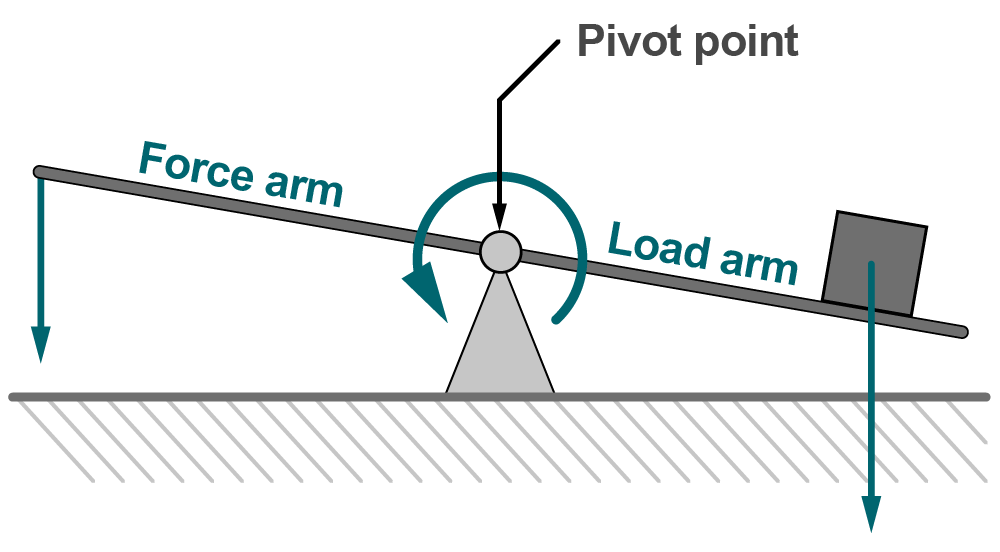
Lever force is defined and calculated using the lever law. For the example above, this ancient principle can be expressed using the following simple formula:
F1 × d1 = m × g × d2
The load arm is the side where the load to be moved is positioned. The power arm is the side where the moving force is applied. The pivot point (also called the fulcrum) is the point around which the lever rotates. Torque is defined as:
M = F x d
Put simply: the longer the lever arm (d), the greater the torque (M).
Calculating leverage for single-sided and double-sided levers
Although the leverage formula for single-sided and double-sided levers is the same, in theory a distinction is made between these two lever types.
| Lever | Characteristics |
|---|---|
| Single-sided lever | • The load arm and power arm coincide, i.e. the lever forces act on only one side of the pivot point • The pivot point is located at one end of the lever arm (outside the two forces) • The forces act in one direction |
| Double-sided lever | • The points of force application are located on both sides of the pivot point •The forces act in two directions |
Example calculation:
As an example of a lever, consider a wheelbarrow used to transport a load of 100kg. By rearranging the formula:
F1 × r1 = m × g × r2
to solve for F1:
F1 = F2 × (r2/r1)
(meaning F1 decreases as the wheelbarrow handles become longer)
and with r2 = 0.6 m and r1 = 1.8 m, the following applies:
F1 = 100 kg x 9,81 m/s² x 0,6 m / 1,8 m = 327 N
Here, 9.81 m/s² represents gravitational acceleration. The result of 327 N is the force required to lift 327 N ÷ 9.81 m/s² = 33.33 kg.
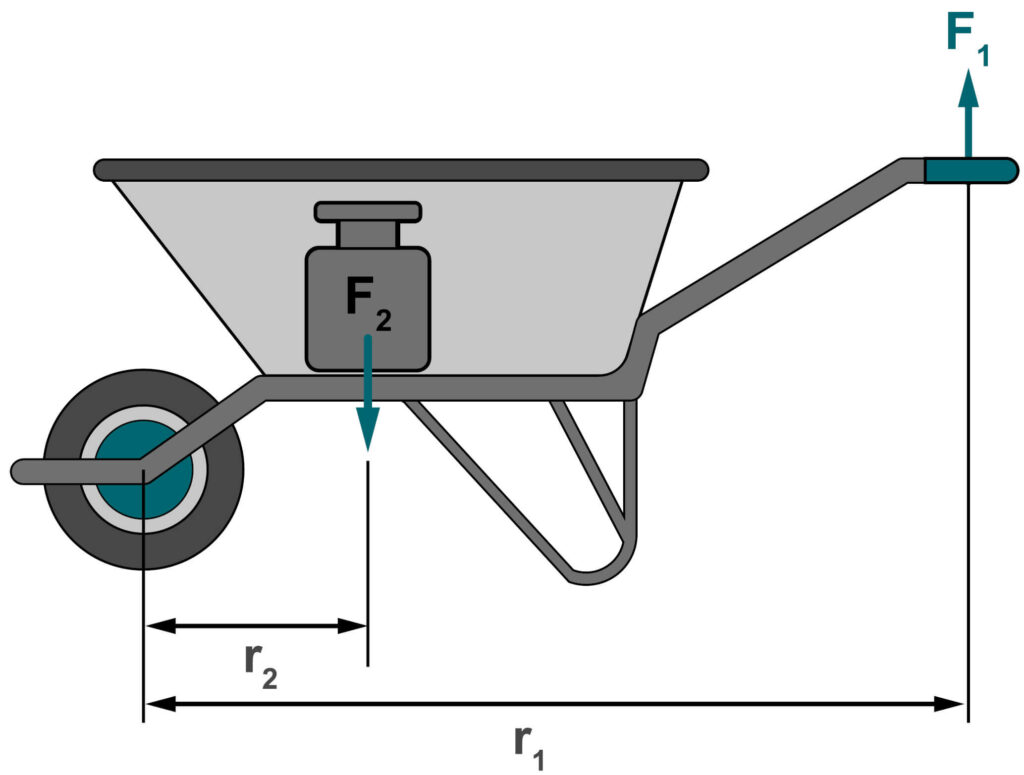
The wheelbarrow and the leverage effect thus reduce the required force by one third. Put another way:
Through mechanical leverage, up to five times as much force can be generated at the second power arm. The formula for calculating leverage on double-sided levers can also be applied to single-sided levers: when moving a loaded wheelbarrow, for instance, both forces act on only one side, yet the loaded weight creates two lever arms of different lengths.
When levers are not straight, they are known as bent levers or angle levers. Angle levers are used, for instance, in inclination balances. For all lever types, friction at the pivot point must also be considered alongside force: when the lever is rotated about its axis, part of the applied energy is converted into heat. An additional force allowance is therefore necessary, depending on the lever material and load.
Lifting equipment: practical use of levers in the workplace
Many types of lifting equipment utilise the leverage effect described by the lever law, reducing the effort required to lift and move heavy loads. These include both manually operated and electro-hydraulic lifting systems and hoisting equipment with and without tilting functions. They are found in logistics as well as on construction sites, combining high load capacity with straightforward, user-friendly handling. Typical lifting equipment in the workplace includes:
- Lever hoists and hand chain hoists
- Cranes
- Material lifts
- Lifting devices
- Level lifters
- Electric chain hoists
Thanks to their high force ratio, lifting equipment provides a lasting reduction in workload across many operational areas. It contributes to effective and safe workflows whilst increasing handling speeds in warehouses and production facilities. Moreover, operating costs can often be significantly reduced by using such high-quality equipment.
FAQs about calculating leverage
In physics and engineering, a lever is known as a force converter: the rigid lever body rotates about its own axis – much like a seesaw. The lever law applies to both single-sided and double-sided levers. The leverage effect enables the lifting and moving of heavy loads with minimal effort.
According to the lever law, lever force for single-sided levers with additional weight as well as double-sided levers can be calculated using this formula: F₁ × r₁ = F₂ × r₂
Levers are divided into single-sided and double-sided levers. Single-sided levers are characterised by the following:
• The load arm and power arm coincide, i.e. the lever forces act on only one side of the pivot point
• The pivot point is located at one end of the lever arm
• The forces act in one direction
Double-sided levers, in turn, are characterised by:
• The points of force application being located on both sides of the pivot point
• The forces acting in two directions
Image source:
© gettyimages.de – PRImageFactory