

Table of contents
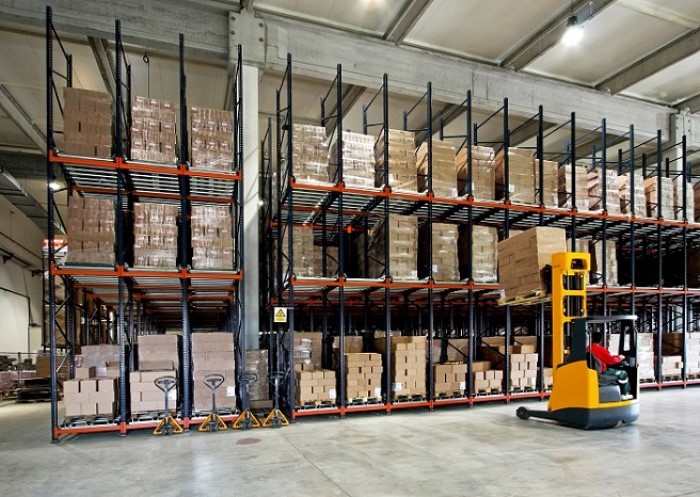
Pallet racking offers many advantages for warehouses and workspaces: it allows for optimal use of floor space and room height, supports automated loading and unloading of goods, and facilitates picking and inventory control.
To ensure that both employees and industrial trucks remain safe, pallet racks must meet certain regulations. In the UK, the use of work equipment such as pallet racking is covered by the Provision and Use of Work Equipment Regulations 1998 (PUWER). While most racking guidance is not legally binding, following it helps meet safety requirements and avoid potential fines. Industry-specific guidelines and codes of practice are provided by the Storage Equipment Manufacturers’ Association (SEMA).
In this guide, we explain the key information on current pallet racking regulations so that you, your staff and your business can operate safely.
What to consider when handling pallet racking
Anyone managing a business or warehouse must take responsibility for implementing measures to ensure compliance with applicable regulations. Detailed regulations for pallet racking on safe pallet rack assembly and operation can be found in Warehousing and Storage: A Guide to Health and Safety (HSG76). To ensure racking is installed to the required standard, SEMA also operates the Storage Equipment Installers Registration Scheme (SEIRS), an industry-recognised competency scheme for racking installers.
We’ve summarised the most important information from these guidelines for you:
- Select a safe surface for pallet racks
 The stability of the floor surface is integral in ensuring that pallet racks stand safe and level. This is even more important for racks that are designed for heavy loads. The surface must be able to support the rack – including its maximum load capacity – and be level enough for the pallet rack to stand perfectly upright. Where required by the manufacturer’s instructions or the installation design, racks must be securely anchored to the floor.
 - Maintain aisle widths and clearances
 You can set up pallet racking in narrow or wide aisles. However, depending on the racking’s location, there are different HSE and SEMA requirements for pallet rack aisle width. These are based on the industrial trucks used in the aisles and the storage height. The positioning of pallet racks relative to walls and other structures should be determined by the type of equipment used, load dimensions, and safe access requirements, in accordance with the manufacturer’s instructions and SEMA guidance
 - Comply with frame and clearance heights
 Pallet rack heights must be planned to ensure safe loading and unloading of pallets. The distance between beam levels should account for the height of the stored goods, while the clearance above the top beam is determined by load dimensions and manufacturer specifications. For pedestrian walkways, a minimum headroom of 2 metres is required under the Workplace (Health, Safety and Welfare) Regulations 1992. For drive-through aisles, the required clearance height depends on the dimensions of the industrial trucks.
 - Calculate and observe load capacity
 When selecting and setting up pallet racking, the load capacity per bay and shelf is essential for preventing overloading – one of the most common causes of racking failure. The load capacity depends on the maximum weight of the goods to be stored and how evenly they are distributed across the beams. Uneven loading can cause beams to become overloaded even when the total weight appears to be within limits. Load capacities must be clearly displayed on a load notice fixed to the racking.
 - Install collision and impact protection
 When industrial trucks such as stacker trucks or pallet trucks are used for loading and unloading stationary pallet racks, collision and impact protection should be fitted at all vulnerable points, including drive-throughs and corners, as direct collisions between vehicles and racking can cause serious damage or destabilise the structure.
Impact protection should be clearly marked in a conspicuous colour to ensure visibility in a busy warehouse environment. Corner protectors or impact protection boards are suitable for this purpose.
Depending on design and type, pallet racks can carry bay loads of up to 9 tonnes for standard frames, medium-duty frames up to 15 tonnes, and heavy-duty frames up to 20 tonnes, making collapse or tipping a serious risk, particularly when industrial trucks operate in racking aisles. For this reason, pallet racks should be subject to regular inspections, as recommended by HSG76 and in good practice under PUWER. For more guidance on safe warehouse operations, browse our warehouse guide.
Further regulations for pallet racking
In addition to the specific intralogistics steps, there are broader regulations to be aware of. For new warehouse constructions or major modifications, the Construction Design and Management (CDM) Regulations 2015 may apply, placing duties on clients, designers and contractors to consider health and safety throughout the project lifecycle.
Wall anchoring and stability
Pallet racks typically carry heavy goods and must be secured against tipping or falling stock. Where required by the installation design or manufacturer’s instructions, this includes anchoring the rack to the floor. Full guidance on stability requirements can be found in HSG76 and the SEMA Code of Practice.
It’s also important that the floor surface is suitable for the planned load. The floor must be capable of withstanding the point loading at each base plate, in line with HSG76. Where minor floor irregularities are present, shim plates can be used.
Fall and push-through protection
Push-through guards are designed to prevent goods from being pushed through the racking or falling during storage. They are not mandatory where the racking has been correctly configured in accordance with SEMA guidance but are strongly recommended where there is insufficient clearance between pallets stored back-to-back in double-depth racking. Push-through guards must not be used as stop rails or positioning guides, as they are not designed to withstand forces of that magnitude.
Fall protection is required when racks are only accessed from one side and vehicle routes, escape routes or workstations are located on the other sides. In these cases, appropriate protection such as back guards should be fitted on non-accessed sides. Where racking is located above a drive-through area, rack covers such as steel panels or wire mesh decking should be used to protect pedestrians and vehicles from falling goods.
Labelling requirements for pallet racking
Clearly visible load capacity signs, known as load notices, are strongly recommended to prevent pallet racks from being accidentally overloaded during daily operations. A compliant load notice should include the following information:
- Maximum safe working load per beam level (shelf load)
- Maximum safe bay load
- Beam heights and key dimensions
- General safety instructions, including guidance on inspections and reporting damage
- Supplier contact details for queries or repairs
Earthquake zone considerations for pallet racking
All pallet racking should be designed in accordance with BS EN 15512:2020, the core structural design standard, alongside SEMA Design Codes. Seismic risk in the UK is generally very low and standard racking designed to this specification does not account for seismic loading. Where racking is to be installed at a location with any identified seismic risk, additional requirements apply. If you are installing racking in such a location, please contact our customer service team.
FAQ for pallet racking regulations
The heavy loads stored on pallet racks increase the risk of accidents. HSG76 and SEMA guidance provide detailed recommendations for pallet racking covering stability, load capacity and aisle width. Complying with this guidance and manufacturer specifications helps ensure the safety of employees and the integrity of materials and equipment.
To prevent overloading during daily work, racks should be fitted with clearly visible load notices. This should clearly display the maximum safe working load per beam level, the maximum safe bay load, key beam heights and dimensions, general safety instructions, and supplier contact details.
If you use stacker trucks or pallet trucks for loading and unloading pallet racks, you must fit the racks with collision and impact protection at drive-throughs and corners. Impact protection should be clearly marked in a conspicuous colour to ensure visibility and must never be used as a positioning guide or back stop.
In most cases, pallet racking is used for the LIFO storage strategy (Last In, First Out), where the most recently stored goods are retrieved first. This approach is particularly suitable for seasonal warehouses. With the addition of roller conveyors or pallet flow lanes, racking can also be configured for the FIFO strategy (First In, First Out), where goods are loaded at one end and retrieved from the other, ensuring older stock is always picked first.
Please note: The regulations mentioned above represent only a selection of the most important legal requirements. Please refer to the listed organisations and directives for more detailed information. If in any doubt, consult experts or contact the relevant regulatory authorities.
Image source:
© gettyimages.de – Halfpoint
© gettyimages.de – Smederevac